
Digitalization is a key factor in the modern economy, contributing to increased productivity, expanded access to services, and integration into global processes. Digital transformation is fundamentally transforming the economy and society. It stimulates growth, innovative activity, and contributes to increased productivity, opening up new opportunities to reduce poverty and inequality, as well as strengthening resilience to external shocks, including climate change.
In Uzbekistan, digital technologies and telecommunications are becoming increasingly important. Thanks to the ongoing reforms in the field of digitalization, the total number of mobile subscribers since 2017 has increased by 13.7 mln and amounted to 36.3 mln people[1], and the number of internet users has almost tripled - to 32.1 mln[2].
According to the Speedtest Global Index, Uzbekistan has made significant progress in the mobile internet speed ranking over the past six years: the country moved from 133rd place in 2020 to 71st place in 2025[3]. According to the E-Government Development Index (EGDI), the country ranked 63rd in 2024, compared to 81st in 2018.
Reasons for the emergence of digital inequality
Despite the progress made, the digital divide between regions, as well as between urban and rural areas, persists, limiting the country’s socio-economic potential. According to international experts, if the digital transformation process is not properly managed, it can exacerbate existing inequalities and undermine the sustainable development of regions.
According to the World Bank (Digital Progress and Trends Report), in low- and middle-income countries, including Uzbekistan, the digital divide exacerbates the gap in poverty levels and reduces labour productivity. While companies in technologically developed countries are actively implementing generative artificial intelligence, in most developing economies, less than half of the businesses have basic internet access[4].
According to expert of the Development Strategy Center, the main reasons for the emergence of digital inequality in Uzbekistan are:
1. Uneven network coverage. According to GSMA, 2G mobile networks cover more regions of Uzbekistan than 3G and 4G, which are mainly concentrated in the city of Tashkent and district centres. In rural areas, the internet speed rarely exceeds 2 Mbit/s, which does not meet the requirements of modern applications. When moving on transport, the speed decreases to 10-50 Kbit/s due to weak signal and switching between base stations. This limits access to digital services and exacerbates social and economic inequality.
 Source: GSMA
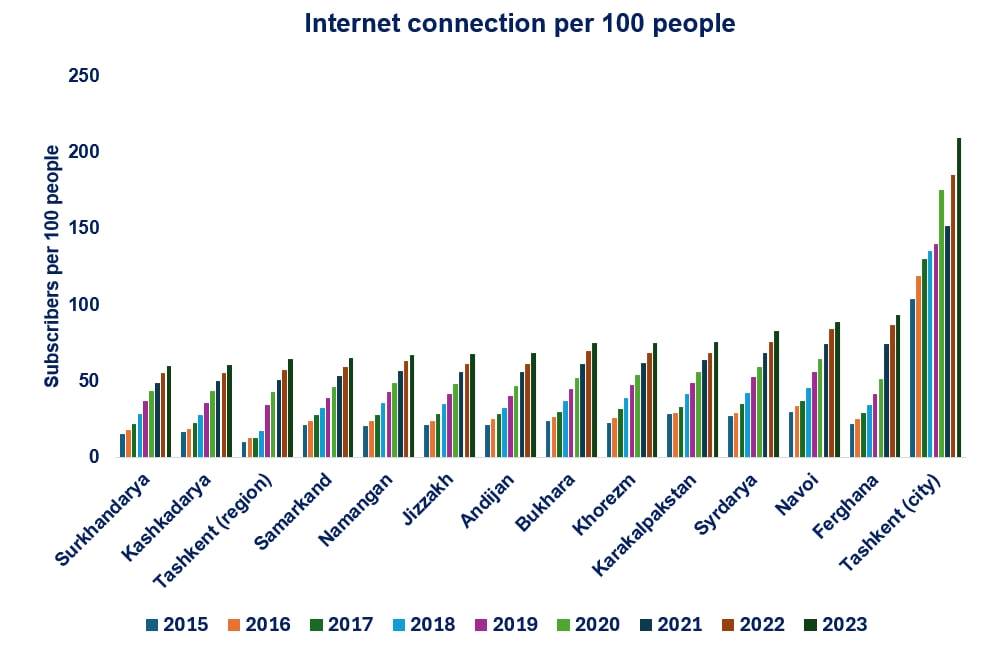
2. High cost of services. According to studies by Freedom House, the internet penetration rate outside Tashkent is significantly lower. The capital has the highest level of internet penetration and broadband access via FTTB technology, significantly exceeding regional indicators. In addition, the infrastructure of information and communication technologies (ICT) depends on stable electricity supply, which is lacking in some rural areas[5]. Due to this, mobile internet remains the main source of connection in rural areas, however, its high cost reduces accessibility for low-income population. As a result, there are 209 internet subscribers per 100 residents in Tashkent, while in most regions they are less than 70. This limits access to government services, online education, and digital business opportunities.
Internet connection per 100 people
3. Low level of digital literacy. The lack of digital skills, especially in rural areas, makes it difficult to use online services. According to UNICEF, only 40% of schoolchildren can use a computer, and only 37% have digital literacy. In rural areas, this figure is even lower - less than 30%[6].
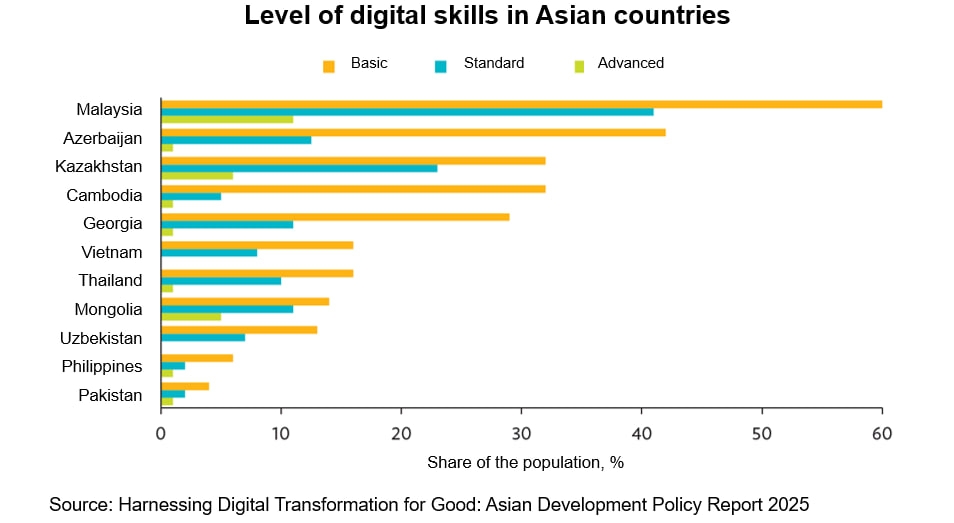
According to the Asian Development Bank (ADB), the level of digital skills necessary to promote digital transformation in developing Asian countries remains generally low. For people to fully benefit from the advantages of digital transformation, the level of ability to master digital technologies is crucial.
As for Uzbekistan, according to ADB experts, only about 15% of the population has basic skills, 7-8% have standard skills, which indicates a low level of digital literacy[7].
The level of digital skills, according to the UN ESCAP classification, is divided into basic (text input, copying), standard (working with applications), and advanced (programming).
4. Insufficient investments in infrastructure. Despite the growth of digital investments in absolute terms, the majority of investments flowing into Uzbekistan are still mainly concentrated in non-digital sectors. Between 2003 and 2024, digital sectors accounted for approximately 5% of foreign direct investment (FDI). Although this share exceeds the indicators of other Central Asian countries such as Turkmenistan, Kyrgyzstan, and Kazakhstan, it remains significantly lower than the average indicators recorded in OECD countries (24%) and non-OECD countries (14%[8]).
Recommendations for reducing digital inequality
According to experts of the Asian Development Bank (ADB), regional economies need to consider their specific economic conditions while forming state policy priorities. The choice of strategies should be based on the level of digitalization, the degree of inclusivity, and sustainability. Compared to the global median level, countries with a low level of digital development, including Uzbekistan, should accelerate digital transformation, focusing on developing digital infrastructure, improving digital skills and literacy, as well as improving the accessibility of digital services[9].
In turn, World Bank experts emphasize that the regional digital divide caused by infrastructural, economic, and educational barriers exacerbates poverty and increases income gaps, limiting people’s access to digital economy opportunities. To minimize these risks, large-scale investments in telecommunications infrastructure, the development of digital skills, and the implementation of inclusive policies are necessary.
To minimize digital inequality and achieve the goals of the “Uzbekistan-2030” Strategy on transferring 100% of public services to electronic format by 2030, the following measures are proposed, based on the experience of other countries and the recommendations of international organizations:
Firstly. The development of Internet exchange points (IXPs) involving major content providers (Google, Netflix) and cloud services contributes to reducing digital inequality.
According to the World Bank's Digital Progress and Trends Report, in low- and middle-income countries, the cost of 1 GB of mobile internet in regions with IXP and connected by leading providers was five times lower, while mobile data consumption was almost three times higher than in countries without IXP.
IXPs provide direct traffic exchange between networks, which reduces costs, decreases delays, and increases internet speed. This is especially important for weakly digitalized regions, including rural areas of Uzbekistan, where connecting through IXP will allow avoiding the use of international channels, improve access in remote areas, reduce delays, and reduce internet costs by up to 20% through local exchange.
In addition, international experts recommend that governments of low- and middle-income countries liberalize the IXP market and ensure that dominant Internet providers do not hinder their use[10].
Secondly. Critical review of educational programs. It is necessary to modernize school and university curricula in computer science and information technology with an emphasis on practice-oriented learning, based on the Malaysian experience #MyDigitalMaker. According to international experts, every dollar invested in IT education brings up to $10 in profit to the country’s economy.
MyDigitalMaker, launched in Malaysia in August 2016, aims to transform young people from ordinary users of digital technologies into active developers and participants in the digital economy[11].
Third. Development and state support of mobile applications to improve the digital literacy of the population. To improve the digital literacy of the population, it is advisable to develop mobile applications in the Uzbek language focused on basic digital skills, internet security, public services, and online education. This is especially important for rural residents, women, and the elderly, where Uzbek language proficiency prevails, while access to technology is limited.
At the same time, it is recommended to launch a state support program for local developers by providing grants, tax benefits, and resources through IT Park Uzbekistan to encourage the creation of localized applications.
In South Korea, the Digital Literacy Program offers applications (e.g., K-MOOC) for learning digital skills, including AI and internet security in Korean.
In India, the Digital India program increased digital literacy by 20% thanks to applications in local languages. The “Digital India” program, launched on July 1, 2015, provides for a comprehensive increase in digital literacy, connecting rural areas to high-speed internet networks, and developing a secure and stable digital infrastructure[12].
Fourth. Creation and development of free Wi-Fi zones in schools, universities, medical institutions, libraries, recreation parks, and cultural institutions, with subsidies for connection and usage costs (subscription fees), based on the successful experience of Estonia. In doing so, providing for the use of solar panels to power Wi-Fi hotspots in rural areas with unstable power supply.
Estonia under the Tiigrihüpe program (1996–2000) connected all schools, including rural ones, to the internet and equipped them with computers, laying the foundation for digital literacy. By 2020, the country had created more than 1,100 free Wi-Fi zones, providing 98% of its territory with wireless Internet access, making Estonia the EU leader in terms of the number of Internet users and second in the world in terms of Internet freedom (Freedom House, 2024)[13].
In conclusion, it should be noted that minimizing the digital divide requires a systematic approach that includes the development of telecommunications infrastructure, reform of educational programs, government support of digital literacy, and stimulation of competition in the digital services market. International experience shows that even with limited resources, significant results can be achieved with clear strategic planning and a focus on vulnerable population groups.
[4] https://openknowledge.worldbank.org/server/api/core/bitstreams/95fe55e9-f110-4ba8-933f-e65572e05395/content
[8] Promoting investment in support of Uzbekistan’s digital transformation, OECD
[9] https://www.adb.org/sites/default/files/publication/1050686/asian-development-policy-report-2025.pdf
 English
 Русский
 О'zbek


