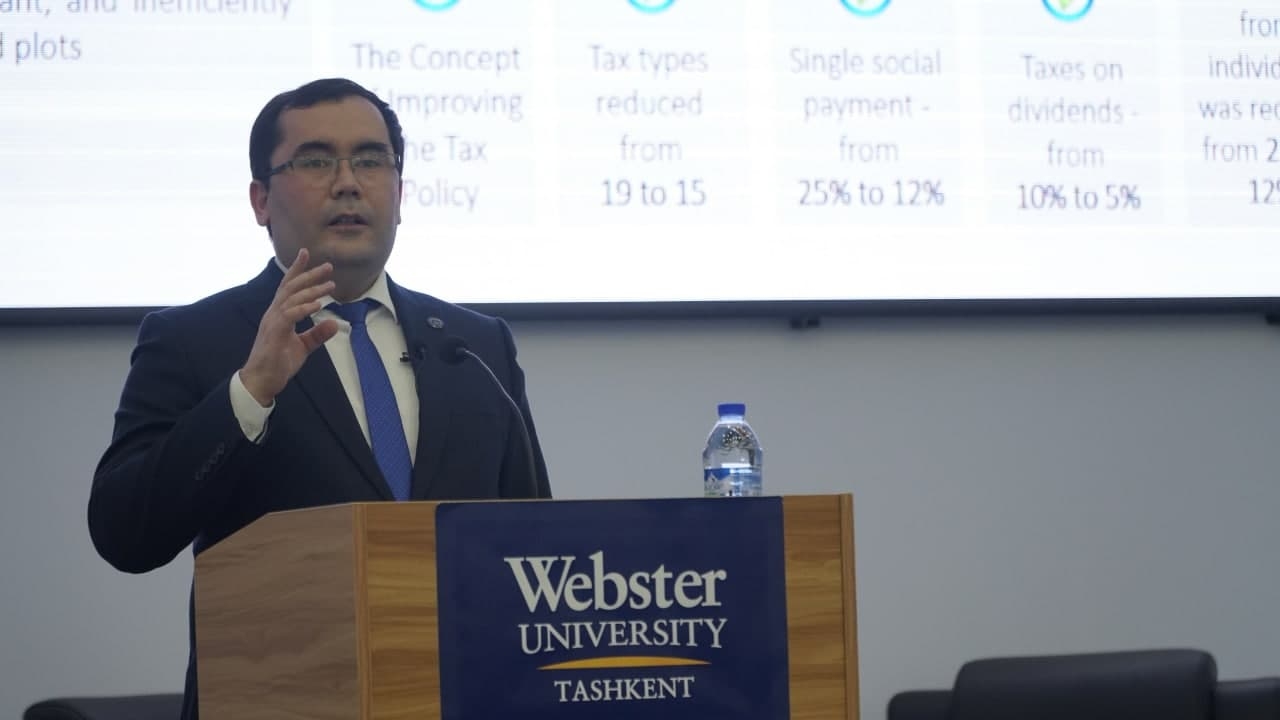
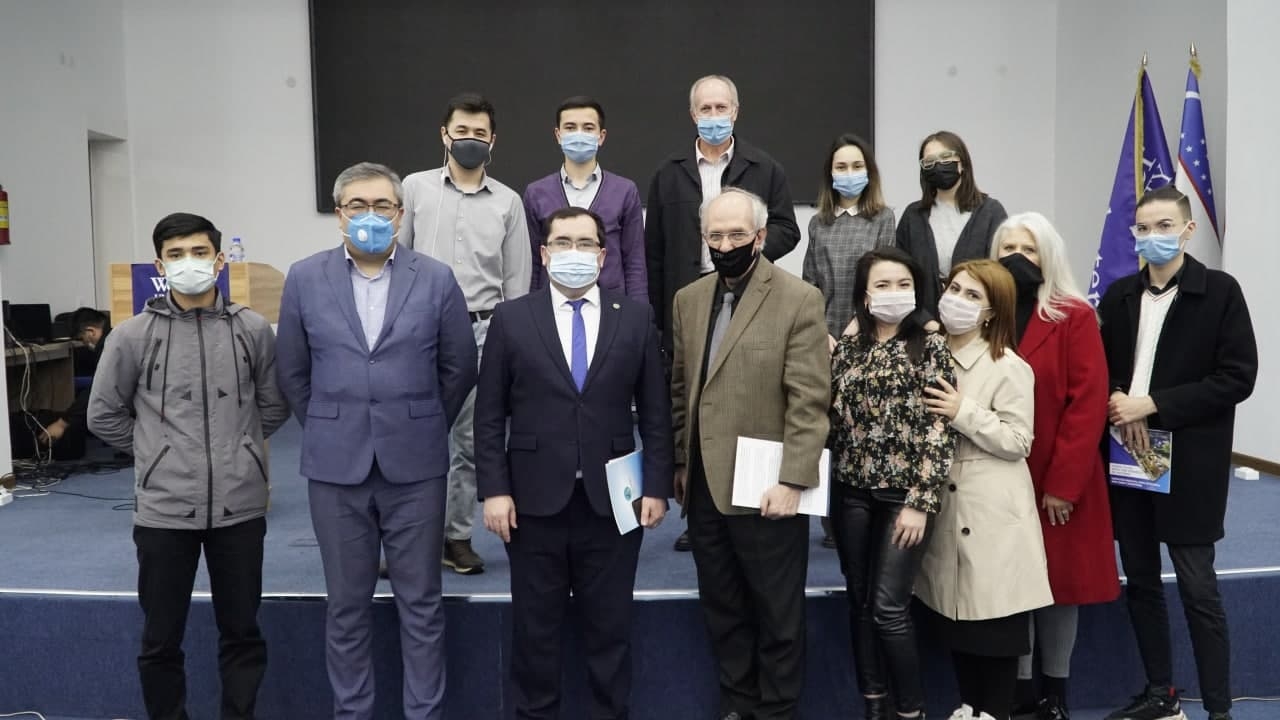
Eldor Tulyakov, Executive Director of the “Development Strategy” Center, made a presentation for the university staff on "Major reforms in Uzbekistan in the framework of the Action Strategy" at the invitation of Webster University in Tashkent. The presentation was watched online by faculty and students, as well as Webster University’s experts in U.S.
In his speech, Eldor Tulyakov noted that over the past four years, Uzbekistan has achieved steady economic growth and, most importantly, is recognized by the international community as a country whose welfare is improving as a result of a number of vital initiatives to ensure social protection. He also analyzed the results achieved within the five areas of the Action Strategy
It was noted that in accordance with the amendments to the legislation based on international experience, there was introduced the procedure for approval of the candidacy of Deputy Prime Ministers, Ministers and Chairmen of State Committees by the Legislative Chamber and the President on the nomination of the Prime Minister. At the same time, it was stipulated that a candidate for a member of the Government should address the deputies with a short-term and long-term action plan for the development of the sector.
Similar reforms have been introduced in the subsystems, including the appointment of heads of regional, district and city government bodies, control by the relevant Councils of People's Deputies over the process of spending local budgets.
As a result of the improvement of the public administration system, many control functions have been transferred to subsystems and streamlined. Chairman of the Council of Ministers of the Republic of Karakalpakstan, khokims of regions and the city of Tashkent have been provided with the authority to independently conclude investment agreements with foreign investors in the equivalent of not more than USD.
In addition, a number of measures have been taken to increase the role and importance of the Action Strategy in ensuring the rule of law and further reforming the judiciary to strengthen the true independence of the judiciary and reliable protection of the rights and freedoms of citizens, in administrative, criminal, civil and economic legislation, the fight against crime and the protection of the rights and legitimate interests of citizens.
In particular, the Supreme Council of Judges was established as a body of judicial power on the basis of the High Qualifications Commission under the President for the Selection and Recommendation of Judges. The Supreme Court and the Supreme Economic Court were merged and the work of the Supreme Court was improved. There was established a Judicial Board on Administrative Cases of the Supreme Court.
The institute of remand of criminal cases for additional investigation by the court has been abolished, and modern information and communication technologies are being effectively applied in the work of courts. A system of "green" and "red" corridors for individuals to enter and leave the customs territory has been introduced.
Difficulties in registration of citizens and issuing visas have been eliminated in order to ensure the rights of citizens to free movement guaranteed by the Constitution. The requirement for notarization of the power of attorney for the use and management of the vehicle among close relatives of the owner of the vehicle was abolished.
It is important to note, that in 2020 alone, a total of 616 convicts were pardoned through adoption of 5 relevant decrees signed by the President.
As a result of the timely implementation of the priorities set out in the Action Strategy, the pace of socio-economic growth of the Republic of Uzbekistan has changed radically.
As a result, the foreign exchange market was liberalized and obligations to sell foreign exchange earnings were abolished. Imports allow for the free purchase of foreign currency and the free withdrawal of profits by foreign investors. Citizens have the opportunity to legally buy and sell foreign currency funds for education or treatment abroad, tourism, business and other purposes without any barriers.
Customs duty rates have been halved. The Government, all ministries and departments and the Central Bank regularly publish all statistical and analytical data on macroeconomic indicators, state budget execution, money supply and the state of gold and foreign exchange reserves.
All necessary conditions have been created for the broad development of small business and private entrepreneurship. As a result, the practice of unscheduled and alternative inspections of business entities was abolished. As a result of the widescale introduction of information technology in the industry, the number of procedures for the provision of public services for business registration, the time required for registration has decreased. The Institute of the Ombudsman for the Protection of the Rights and Legal Interests of Business Entities was established.
At the same time, the state's participation in the economy has been reduced. A special fund to support privatized enterprises has been set up, and new production facilities have been launched at the sites of inactive and non-operating enterprises. The favorable investment climate and foreign economic activity have been liberalized, and the approach to relations with partner countries and international financial institutions has changed. Most importantly, a full-fledged relationship with the European Bank for Reconstruction and Development has been restored. In the World Bank's Doing Business 2018 report, Uzbekistan was included in the list of "top 10 reformist countries" that have created the most favorable conditions for doing business.
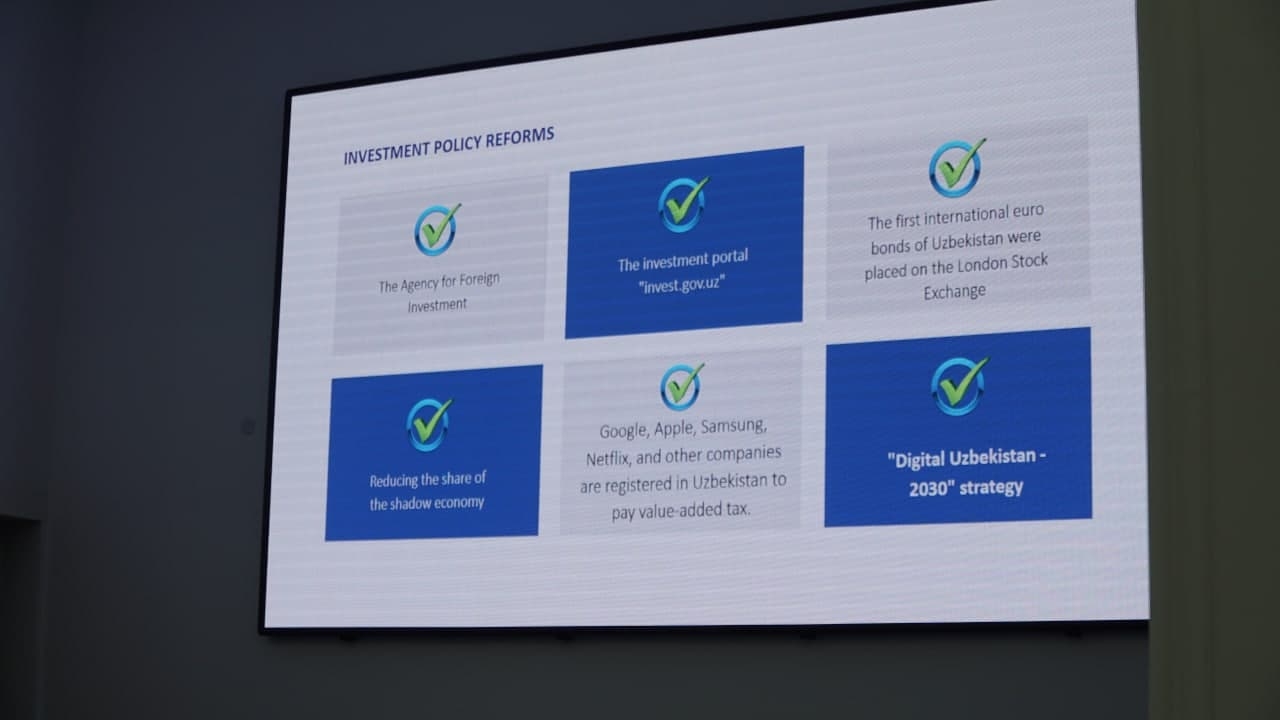
The strategy "Digital Uzbekistan - 2030" has been approved.
It is noteworthy that significant work has been done on the development of the social sphere. Concepts of development of the healthcare system of the Republic of Uzbekistan for 2019-2025 and development of the higher education system of the Republic of Uzbekistan until 2030 were approved.
By the end of 2020, the coverage of preschool education will reach 60.9%, and within the framework of the concept of development of the preschool education system of the Republic of Uzbekistan until 2030, the goal is to cover 80.8% of preschool children by 2030.
A national test system for assessing the level of knowledge of general education subjects has been introduced, and two-thirds of all secondary schools in the country are connected to the high-speed Internet.
Today, in 35 out of 132 higher education institutions operating in the country, the educational process has been transferred to the credit-module system. Self-financing has been established in 10 higher education institutions.
Over recent the years, a constructive foreign policy has been consistently pursued. In particular, during the historic visit of President Shavkat Mirziyoyev to the United States, Shavkat Mirziyoyev addressed the 72nd session of the UN General Assembly for the first time as President of the Republic of Uzbekistan. At the initiative of Uzbekistan, a special resolution of the UN General Assembly "Enlightenment and religious tolerance" was adopted.
Also, the international conference on Afghanistan was also held in Tashkent, which resulted in the adoption of the Tashkent Declaration on Peace in Afghanistan.
Out of the more than 20,000 people excluded from the "special accounts", about 16,000 were socially rehabilitated. As a result of Uzbekistan's constructive foreign policy, for the first time since 2006, Uzbekistan has been removed from the list of "countries of particular concern" in the religious sphere, becoming the second country to be deregistered by the US State Department in the last 20 years. The National Strategy of the Republic of Uzbekistan on Human Rights was adopted.
Uzbekistan has become a full member of the Cooperation Council of Turkic Speaking States. Uzbekistan's membership in the Council has helped to create favorable conditions for trade and investment, simplify customs and transit procedures, as well as financial and banking operations for the gradual transition to free movement of goods, capital, services and technology.
On February 3, 2020, US Secretary of State Michael Pompeo visited Uzbekistan, met with President Mirziyoyev and took part in a regular meeting of Central Asian and US Foreign Ministers in the form of "Central Asia - USA" ("C5 + 1").
At the end of the presentation, the University staff acknowledged the special role of the “Development Strategy” Center in the timely and effective implementation of reforms under the Action Strategy, and thanked the staff of the Center.
“Development Strategy” Center
Information service.
 English
 Русский
 О'zbek


Eldor Tulyakov, Executive Director of the “Development Strategy” Center, made a presentation for the university staff on "Major reforms in Uzbekistan in the framework of the Action Strategy" at the invitation of Webster University in Tashkent. The presentation was watched online by faculty and students, as well as Webster University’s experts in U.S.
In his speech, Eldor Tulyakov noted that over the past four years, Uzbekistan has achieved steady economic growth and, most importantly, is recognized by the international community as a country whose welfare is improving as a result of a number of vital initiatives to ensure social protection. He also analyzed the results achieved within the five areas of the Action Strategy
It was noted that in accordance with the amendments to the legislation based on international experience, there was introduced the procedure for approval of the candidacy of Deputy Prime Ministers, Ministers and Chairmen of State Committees by the Legislative Chamber and the President on the nomination of the Prime Minister. At the same time, it was stipulated that a candidate for a member of the Government should address the deputies with a short-term and long-term action plan for the development of the sector.
Similar reforms have been introduced in the subsystems, including the appointment of heads of regional, district and city government bodies, control by the relevant Councils of People's Deputies over the process of spending local budgets.
As a result of the improvement of the public administration system, many control functions have been transferred to subsystems and streamlined. Chairman of the Council of Ministers of the Republic of Karakalpakstan, khokims of regions and the city of Tashkent have been provided with the authority to independently conclude investment agreements with foreign investors in the equivalent of not more than USD.
In addition, a number of measures have been taken to increase the role and importance of the Action Strategy in ensuring the rule of law and further reforming the judiciary to strengthen the true independence of the judiciary and reliable protection of the rights and freedoms of citizens, in administrative, criminal, civil and economic legislation, the fight against crime and the protection of the rights and legitimate interests of citizens.
In particular, the Supreme Council of Judges was established as a body of judicial power on the basis of the High Qualifications Commission under the President for the Selection and Recommendation of Judges. The Supreme Court and the Supreme Economic Court were merged and the work of the Supreme Court was improved. There was established a Judicial Board on Administrative Cases of the Supreme Court.
The institute of remand of criminal cases for additional investigation by the court has been abolished, and modern information and communication technologies are being effectively applied in the work of courts. A system of "green" and "red" corridors for individuals to enter and leave the customs territory has been introduced.
Difficulties in registration of citizens and issuing visas have been eliminated in order to ensure the rights of citizens to free movement guaranteed by the Constitution. The requirement for notarization of the power of attorney for the use and management of the vehicle among close relatives of the owner of the vehicle was abolished.
It is important to note, that in 2020 alone, a total of 616 convicts were pardoned through adoption of 5 relevant decrees signed by the President.
As a result of the timely implementation of the priorities set out in the Action Strategy, the pace of socio-economic growth of the Republic of Uzbekistan has changed radically.
As a result, the foreign exchange market was liberalized and obligations to sell foreign exchange earnings were abolished. Imports allow for the free purchase of foreign currency and the free withdrawal of profits by foreign investors. Citizens have the opportunity to legally buy and sell foreign currency funds for education or treatment abroad, tourism, business and other purposes without any barriers.
Customs duty rates have been halved. The Government, all ministries and departments and the Central Bank regularly publish all statistical and analytical data on macroeconomic indicators, state budget execution, money supply and the state of gold and foreign exchange reserves.
All necessary conditions have been created for the broad development of small business and private entrepreneurship. As a result, the practice of unscheduled and alternative inspections of business entities was abolished. As a result of the widescale introduction of information technology in the industry, the number of procedures for the provision of public services for business registration, the time required for registration has decreased. The Institute of the Ombudsman for the Protection of the Rights and Legal Interests of Business Entities was established.
At the same time, the state's participation in the economy has been reduced. A special fund to support privatized enterprises has been set up, and new production facilities have been launched at the sites of inactive and non-operating enterprises. The favorable investment climate and foreign economic activity have been liberalized, and the approach to relations with partner countries and international financial institutions has changed. Most importantly, a full-fledged relationship with the European Bank for Reconstruction and Development has been restored. In the World Bank's Doing Business 2018 report, Uzbekistan was included in the list of "top 10 reformist countries" that have created the most favorable conditions for doing business.
The strategy "Digital Uzbekistan - 2030" has been approved.
It is noteworthy that significant work has been done on the development of the social sphere. Concepts of development of the healthcare system of the Republic of Uzbekistan for 2019-2025 and development of the higher education system of the Republic of Uzbekistan until 2030 were approved.
By the end of 2020, the coverage of preschool education will reach 60.9%, and within the framework of the concept of development of the preschool education system of the Republic of Uzbekistan until 2030, the goal is to cover 80.8% of preschool children by 2030.
A national test system for assessing the level of knowledge of general education subjects has been introduced, and two-thirds of all secondary schools in the country are connected to the high-speed Internet.
Today, in 35 out of 132 higher education institutions operating in the country, the educational process has been transferred to the credit-module system. Self-financing has been established in 10 higher education institutions.
Over recent the years, a constructive foreign policy has been consistently pursued. In particular, during the historic visit of President Shavkat Mirziyoyev to the United States, Shavkat Mirziyoyev addressed the 72nd session of the UN General Assembly for the first time as President of the Republic of Uzbekistan. At the initiative of Uzbekistan, a special resolution of the UN General Assembly "Enlightenment and religious tolerance" was adopted.
Also, the international conference on Afghanistan was also held in Tashkent, which resulted in the adoption of the Tashkent Declaration on Peace in Afghanistan.
Out of the more than 20,000 people excluded from the "special accounts", about 16,000 were socially rehabilitated. As a result of Uzbekistan's constructive foreign policy, for the first time since 2006, Uzbekistan has been removed from the list of "countries of particular concern" in the religious sphere, becoming the second country to be deregistered by the US State Department in the last 20 years. The National Strategy of the Republic of Uzbekistan on Human Rights was adopted.
Uzbekistan has become a full member of the Cooperation Council of Turkic Speaking States. Uzbekistan's membership in the Council has helped to create favorable conditions for trade and investment, simplify customs and transit procedures, as well as financial and banking operations for the gradual transition to free movement of goods, capital, services and technology.
On February 3, 2020, US Secretary of State Michael Pompeo visited Uzbekistan, met with President Mirziyoyev and took part in a regular meeting of Central Asian and US Foreign Ministers in the form of "Central Asia - USA" ("C5 + 1").
At the end of the presentation, the University staff acknowledged the special role of the “Development Strategy” Center in the timely and effective implementation of reforms under the Action Strategy, and thanked the staff of the Center.
“Development Strategy” Center
Information service.