Jamshid Sharipov - Head of the
Department of the Development Strategy Center
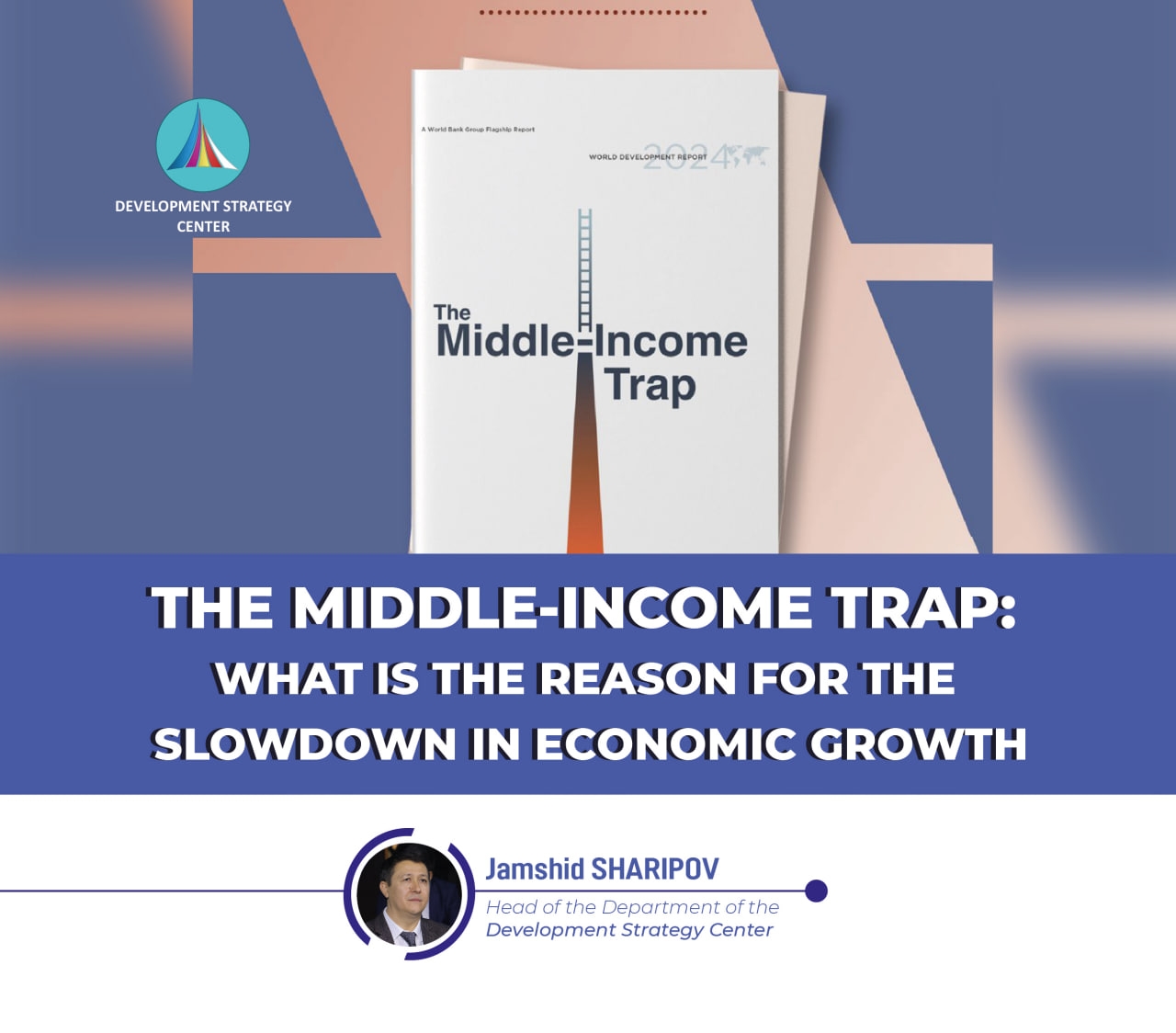
The World Bank team has published the latest report, “World Development Report 2024: The Middle-Income Trap” (WDR 2024), which is an in-depth analysis of the challenges and opportunities for middle-income countries (i.e., with GDP per capita from US$1,136 to US$13,845)[1].
According to WDR 2024, 108 countries, including Uzbekistan, risk being stuck in a “middle income trap” if their GDP per capita remains below 10% of the US level, which is equivalent to $8,000.
For Uzbekistan, classified as a low middle-income country (GDP per capita of about 2,849 USD in 2023[2] ), this problem becomes especially relevant in the context of global challenges - climate change, increasing protectionism and demographic shifts.
The “middle-income trap” is a concept first introduced by the World Bank in its 2007 report “An East Asian Renaissance”, which describes a situation where countries, having reached middle-income status, experience slowing economic growth and fail to move to high-income status.
The report proposes the “Three I Strategy” for governments seeking to achieve high-income status. Depending on the stage of development, all countries need to apply a coherent and progressively more complex set of policies.
Low-income countries can focus solely on policies to boost investment – this is the “I-1” stage. But once they move into the lower-middle-income category, they should change tactics and expand their policy actions mix to the “I-2” stage, which combines investment with “infusions” of foreign technologies, that is, their adoption and dissemination in various sectors of the economy.
Once countries have reached upper-middle income levels, they should change tactics again and move to the final - “I-3” stage, which combines investment, technological “infusions” and innovation. In the innovation phase, countries are no longer simply borrowing ideas from the world's leading technological edges - they are expanding those edges.
This analytical paper examines the current situation in Uzbekistan, key obstacles to sustainable growth and measures to overcome the “middle income trap”.
Current situation in Uzbekistan
Uzbekistan has demonstrated sustained economic growth since the reforms launched in 2017, including the liberalization of the foreign exchange market, improvement of the business climate, and reduction of extreme poverty.
According to the World Bank, Uzbekistan's GDP per capita increased to $2,849 in 2023, placing the country in the lower middle-income category ($1,100–$4,300).
Thanks to large-scale reforms, infrastructure modernization and investment attraction, Uzbekistan's economy continued to demonstrate positive dynamics in 2024. In particular, the poverty rate decreased to 8.9%, inflation - to 9.8%, GDP grew by 6.5%, and exports - by 8.3%. At the same time, the young population (the average age is about 28 years) and the ambitious strategy "Uzbekistan-2030", aimed at digitalization and modernization, create potential for further development.
Why did countries fell into the 'Middle Income Trap'
According to World Bank experts, low economic diversification, outdated economic models, institutional constraints, climate change and protectionism make countries vulnerable to stagnation. These factors correspond to the description of the “middle-income trap” presented in the WDR 2024 report.
Uzbekistan faces a number of structural, institutional and external barriers that slow its transition to higher income levels. According to the WDR 2024 analysis, the middle-income trap occurs when countries fail to overcome these barriers and adapt to new economic realities. The report then examines the key reasons keeping Uzbekistan in the middle-income trap.
Access to global technologies is limited for several reasons.
First, Uzbekistan is poorly integrated into international supply chains, which makes it difficult to transfer advanced technologies and know-how.
Second, the research and development (R&D) sector is underfunded: R&D expenditure is less than 0.12% of GDP[3], which is significantly below the average for countries with a similar income.
Third, a shortage of skilled personnel exacerbates the problem: despite a high literacy rate, the education system is not sufficiently focused on training specialists in the field of high technologies. For example, technical specialties account for only 14% of university graduates, creating a shortage of engineers and IT specialists[4].
In turn, the chart below shows that the cost of capital for renewable energy in low-middle-income countries, including Uzbekistan, exceeds 8.5%, which is twice as high as in high-income countries, creating financial barriers to the transition to green energy. According to World Bank experts, the dominance of state-owned enterprises in the energy sector and outdated infrastructure further complicates the situation.

How to get out of the “middle income trap”
According to the director of the World Development Report 2024 (WDR 2024) - the way forward will not be easy, but countries can make progress even in today's challenging environment.
Uzbekistan, as a low-middle income country, is in a difficult stage where traditional investment-based growth strategies are exhausting themselves. In this regard, for countries stuck in the "middle income trap", WDR 2024 recommends reforms in the following directions:
South Korea started by investing in basic infrastructure in the 1960s, then moved to adopting foreign technology in the 1970s (for example, Samsung licensed technology from Japanese companies Sanyo and NEC), and later became an innovation leader, achieving a per capita GDP of $33,000 by 2023.
Poland has increased productivity through Western European technologies, and Chile has adapted Norwegian salmon farming technology to become a major exporter. These countries demonstrate how moving through successive steps in the “I-3” (investments, technologies, innovations) can help break out of the middle-income trap.
Without a transition to the “I-2” strategy, the country risks getting stuck in a “middle-income trap”, especially in the face of climate, geopolitical and social challenges.
Also, World Bank experts recommend the introduction of laws to strengthen independent regulators, which is applicable to Uzbekistan. Since research results show that the high cost of capital (8.5% for countries like Uzbekistan) hinders "green" investments. Independent regulators, as in the case of Poland (Urząd Regulacji Energetyki), can reduce this cost through transparent rules, which is applicable to the energy sector of Uzbekistan.
According to the National Statistics Committee of Uzbekistan, about 10% of students are studying in natural sciences and ICT, which is significantly lower than in countries that have successfully transitioned to high-income economies, such as South Korea, where this figure reached 30–40% in the 1980s. The shortage of specialists in STEM limits innovation and the development of high-tech industries. For example, in Uzbekistan, the share of high-tech exports is only 1.4% of the total[7], while on average in high-income countries this figure exceeds 20%[8].
Uzbekistan’s energy sector remains the main source of greenhouse gas emissions, accounting for about 75% of total emissions, due to its high dependence on natural gas (85% of the country’s gas is used to generate electricity). According to World Bank estimates, Uzbekistan will need to invest $341 billion in the energy transition, including infrastructure modernization and renewable energy development, to achieve carbon neutrality by 2060[9].
The introduction of energy-efficient technologies can significantly reduce gas consumption. For example, the modernization of outdated thermal power plants, which account for more than 80% of electricity generation, will reduce energy losses, which reach 20-30% in the current system. In addition, the transition to energy-efficient solutions in industry and the residential sector, such as thermal insulation of buildings and the use of heat pumps, can reduce the demand for gas for heating, which accounts for a significant share of consumption (about 25 billion cubic meters annually).
Subsidies for renewable energy sources play a key role in diversifying the energy balance. Currently, the share of renewable energy sources in the total volume of electricity production in the country is almost 10%[10], mainly due to hydropower, while the potential of solar and wind energy remains virtually untapped.
Uzbekistan plans to increase renewable energy capacity to 25,000 megawatts and its share in total consumption to 40% by 2030, while simultaneously reducing emissions of pollutants into the atmosphere by 10.5%[11]. However, the high cost of capital remains a barrier to scaling up “green” projects.
In developing countries, including Uzbekistan, interest rates on loans for renewable energy projects may reach not less than 15%, which is two to three times higher than in developed countries. The WDR 2024 report highlights that international financing through partnerships with organizations such as the International Finance Corporation (IFC) and the Asian Development Bank (ADB) can reduce these costs.
For example, IFC has provided $240 million for solar power and energy storage projects in Uzbekistan in 2024, which will reduce carbon emissions by 1.3 million tons annually[12]. Mechanisms such as payment guarantees and concessional loans attract private investors, reducing risks and making projects economically viable.
In conclusion, it should be noted that Uzbekistan is at a stage where the traditional drivers of growth - investment in infrastructure and export of raw materials - are exhausting their potential, which confirms the relevance of the WDR 2024 conclusions. Implementation of the proposed measures - technological modernization, institutional strengthening, human capital development and “green” transformation - will allow Uzbekistan to accelerate economic growth and approach the status of a high-income country, as envisaged in the Strategy “Uzbekistan-2030”.
[4] https://tat.uz/ru/press-tsentr/novosti-goskomstata/51531-oliy-ta-lim-tashkilotlarining-bakalavriat-yo-nalishida-necha-nafar-talaba-tahsil-olgan-2
[5] https://documents1.worldbank.org/curated/en/099111423124532434/pdf/P1790681e5fb89481911d142b818f571f046c76bbe10.pdf
[6] https://documents1.worldbank.org/curated/en/099242105192220964/pdf/IDU0758ddc1d080600405008fee0f9bb83305e7d.pdf
 English
 Русский
 О'zbek


