On 20-22 November this year, in Nanjing, one of China’s economic, scientific and educational centres, the Xinhua Institute held an international forum of think tanks on cooperation within the framework of the Belt and Road Initiative.
The international forum was attended by representatives of authoritative think tanks, political and business circles, national news agencies and media outlets from countries cooperating within the framework of the Belt and Road Initiative.
At the conference, participants exchanged views on the strategic importance of the Belt and Road Initiative in the context of contemporary global challenges, competition and cooperation, its role in regional cooperation, infrastructure renewal and development of digital economy. One of the main goals of the event was to establish a permanent dialogue platform between think tanks from different countries, strengthen scientific and practical cooperation, and enrich strategic initiatives with scientific foundations.
The event featured international perspectives and proposals on a number of priority areas, such as transport logistics, energy security, digital transformation, joint investment projects and information exchange.
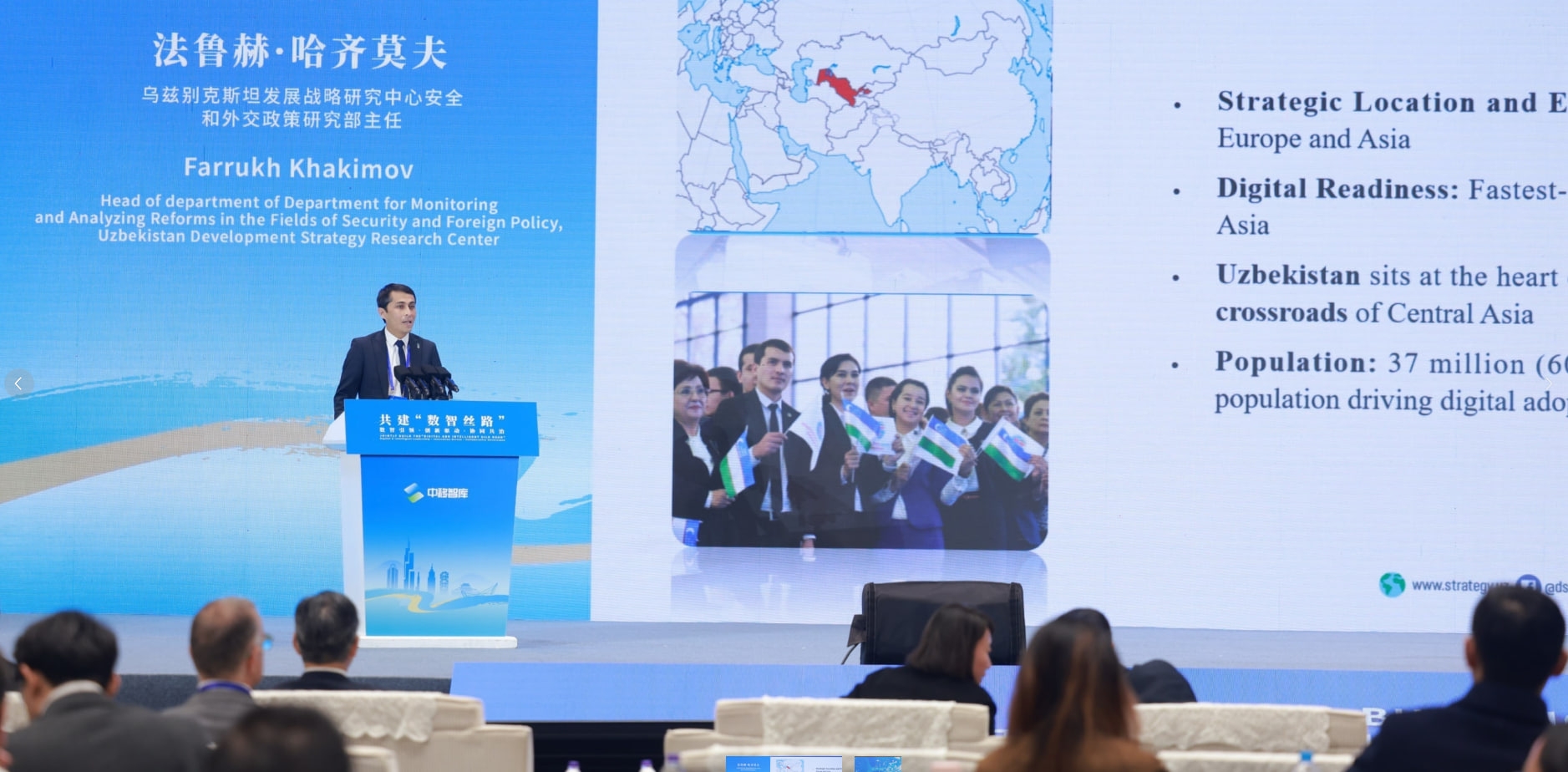
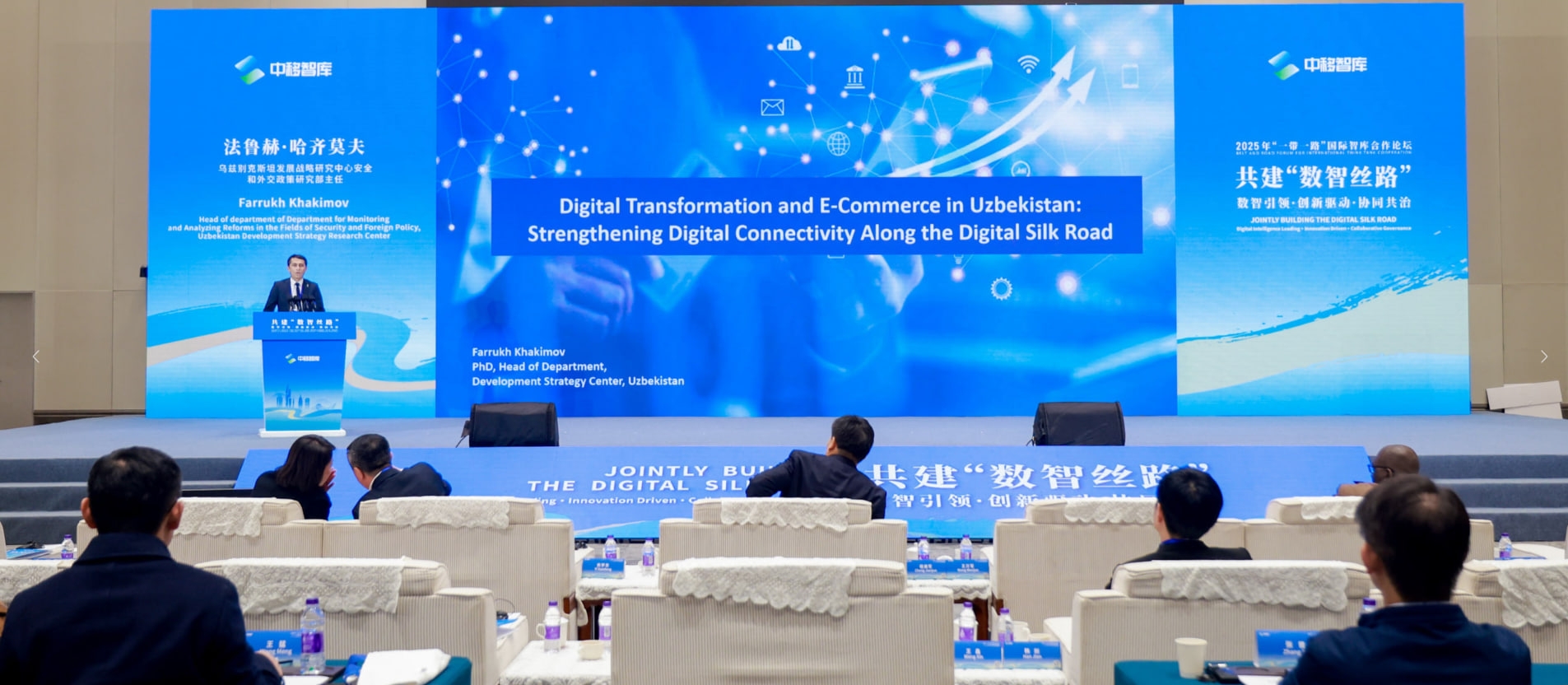
At the forum session on the Digital Silk Road, Farrukh Hakimov, Head of Department at the Development Strategy Center, gave a presentation on the reforms being carried out in our country in the field of digitalisation and gave a presentation on the reforms being carried out as part of the ‘Digital Uzbekistan – 2030’ and ‘Uzbekistan – 2030’ strategies and their practical results.
It was noted in the report that Uzbekistan’s digital transformation has been progressing rapidly in recent years, and practical measures to increase internet coverage and speed, train personnel in ICT and new technologies, increase the share of IT services in the national economy and exports, developing digital infrastructure, and expanding international cooperation in the digital sphere are yielding results.
As noted in the presentation, among 193 countries in the UN E-Government Development Index, Uzbekistan climbed from 87th (2020) to 63rd (2024). In addition, Uzbekistan rose 17 positions in the International AI Readiness Index and ranked first among Central Asian countries. As a result of the introduction of new digital services on the ‘E-Government’ Unified Portal of Interactive Government Services, their total number reached 775, and the number of users exceeded 11.6 million people.
At the same time, cooperation with major foreign ICT companies is expanding, including a number of projects in the field of digital transformation and digitalisation with Chinese companies Huawei, ZTE and others.
Based on the forum’s results, establishing ongoing cooperation between participating countries and think tanks, coordinating research areas, jointly analysing current global trends, and scientifically substantiating the Belt and Road Initiative became particularly important issues.
Also, joint proposals were put forward on developing cooperation in the field of new technologies, implementing the concept of the Digital Silk Road, supporting innovative projects and ensuring ongoing dialogue between think tanks.
Development Strategy Centеr
Information Servic
 English
 Русский
 О'zbek


On 20-22 November this year, in Nanjing, one of China’s economic, scientific and educational centres, the Xinhua Institute held an international forum of think tanks on cooperation within the framework of the Belt and Road Initiative.
The international forum was attended by representatives of authoritative think tanks, political and business circles, national news agencies and media outlets from countries cooperating within the framework of the Belt and Road Initiative.
At the conference, participants exchanged views on the strategic importance of the Belt and Road Initiative in the context of contemporary global challenges, competition and cooperation, its role in regional cooperation, infrastructure renewal and development of digital economy. One of the main goals of the event was to establish a permanent dialogue platform between think tanks from different countries, strengthen scientific and practical cooperation, and enrich strategic initiatives with scientific foundations.
The event featured international perspectives and proposals on a number of priority areas, such as transport logistics, energy security, digital transformation, joint investment projects and information exchange.
At the forum session on the Digital Silk Road, Farrukh Hakimov, Head of Department at the Development Strategy Center, gave a presentation on the reforms being carried out in our country in the field of digitalisation and gave a presentation on the reforms being carried out as part of the ‘Digital Uzbekistan – 2030’ and ‘Uzbekistan – 2030’ strategies and their practical results.
It was noted in the report that Uzbekistan’s digital transformation has been progressing rapidly in recent years, and practical measures to increase internet coverage and speed, train personnel in ICT and new technologies, increase the share of IT services in the national economy and exports, developing digital infrastructure, and expanding international cooperation in the digital sphere are yielding results.
As noted in the presentation, among 193 countries in the UN E-Government Development Index, Uzbekistan climbed from 87th (2020) to 63rd (2024). In addition, Uzbekistan rose 17 positions in the International AI Readiness Index and ranked first among Central Asian countries. As a result of the introduction of new digital services on the ‘E-Government’ Unified Portal of Interactive Government Services, their total number reached 775, and the number of users exceeded 11.6 million people.
At the same time, cooperation with major foreign ICT companies is expanding, including a number of projects in the field of digital transformation and digitalisation with Chinese companies Huawei, ZTE and others.
Based on the forum’s results, establishing ongoing cooperation between participating countries and think tanks, coordinating research areas, jointly analysing current global trends, and scientifically substantiating the Belt and Road Initiative became particularly important issues.
Also, joint proposals were put forward on developing cooperation in the field of new technologies, implementing the concept of the Digital Silk Road, supporting innovative projects and ensuring ongoing dialogue between think tanks.
Development Strategy Centеr
Information Servic