 Jamshid Sharipov
Head of Department,
Development Strategy Center
Traffic Congestion Is More Than Just Lost Time
Around 5.2 million people travel around Tashkent every day. Traffic volumes on 81 of the city’s main streets reach 770,000 vehicles per day, while their estimated design capacity is approximately 400,000 vehicles. In other words, the actual traffic load is almost 1.9 times higher than the capacity for which these roads were designed. According to the Tashkent Traffic Management Centre (TTMC), congestion causes annual economic losses of USD 343 million, equivalent to 1.27% of the capital’s gross regional product.
However, these losses can be reduced not only by building new roads. There is considerable scope to improve the way traffic is managed: adjusting traffic signals to reflect actual traffic flows, coordinating roadworks and making better use of digital data. The first results of these efforts are already visible in Tashkent.
Infrastructure Is Expanding, but Traffic Loads Are Rising
Uzbekistan’s transport sector accounts for almost 8% of GDP and provides employment for around one million people. In recent years, the country has risen from 129th to 88th place in the World Bank’s Logistics Performance Index. In 2025, transit freight volumes reached 15.3 million tonnes, and the target is to increase this figure to 18.5 million tonnes by 2030.
Major infrastructure projects are also under way. The World Bank has approved USD 200 million in financing for the reconstruction of a 91-kilometre section of the M41 road. The average speed on this route is expected to increase from 65 km/h to approximately 90 km/h. A 282-kilometre, six-lane toll motorway between Tashkent and Samarkand is also under construction.
At the same time, the expansion of the road network needs to be accompanied by more efficient use of existing infrastructure. According to the World Bank, Uzbekistan will need to increase the capacity of its roads by approximately 500% by 2030 to accommodate projected growth in freight traffic. This points to the need to combine investment in infrastructure with modern traffic management.
Traffic Signals That Respond to Actual Traffic Flows
An important step was the establishment of the Traffic Management Centre in Tashkent. Under a presidential resolution dated 4 December 2025, the Centre was granted powers relating to digital traffic management, oversight of roadworks and improvements in road safety. According to the Centre, adaptive traffic signals are already operating at 271 intersections, and a transport macromodel of the capital has been developed.
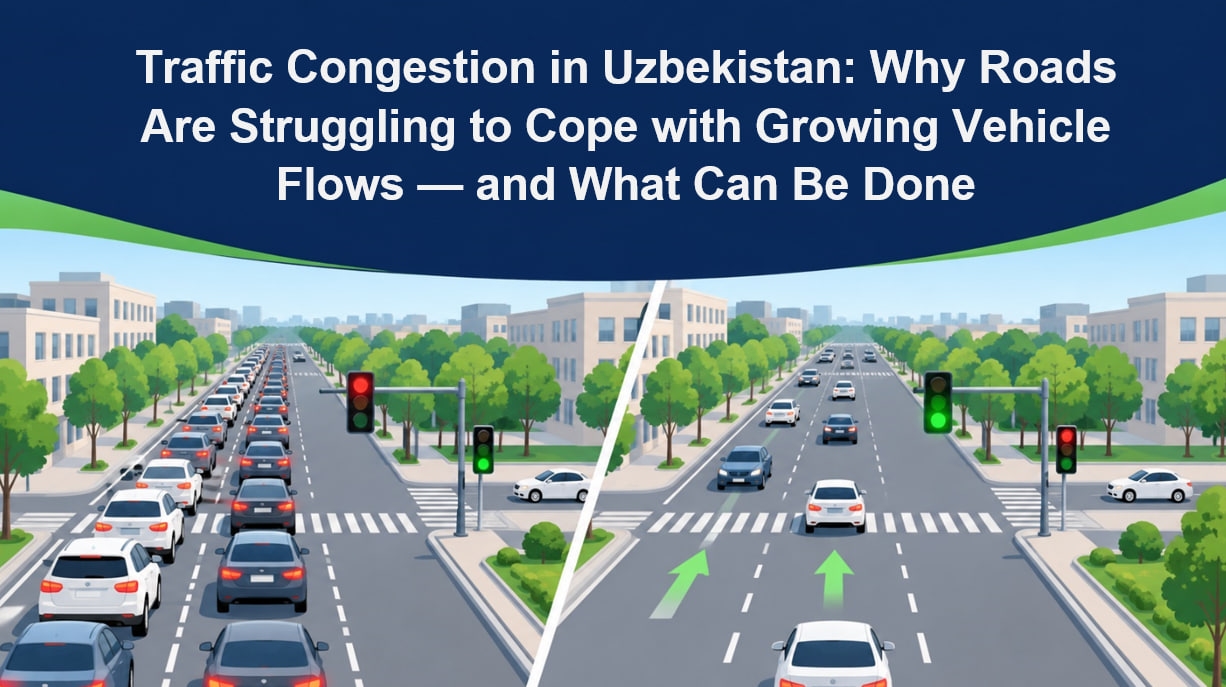
The initial results of traffic-signal coordination demonstrate the benefits of precise signal timing. On Buyuk Ipak Yuli Street, the coordination of 13 traffic lights using a “green wave” system reduced travel time towards the city centre by 29% — from 8.5 minutes to 6 minutes. Travel time in the opposite direction fell by 20%. On Makhtumkuli Street, which carries around 90,000 vehicles a day, the coordination of 11 traffic lights increased the capacity of the route by 12% and reduced travel time by 10%.
At the intersection of Fitrat and Heydar Aliyev streets, an analysis of traffic flows led to the green-light phase for the busiest direction being extended to almost twice its previous duration. This was accompanied by a reduction in queues. According to the Traffic Management Centre, traffic volumes increased by 30% on 2 September 2026, the first day of the school year. Nevertheless, prompt adjustments to traffic-signal phases helped keep the congestion level at around six points.
Three Reasons Roads Are Losing Capacity
The first reason is the overloading of the road network. The vehicle fleet and traffic volumes are growing faster than the capacity of many roads, with congestion particularly concentrated during peak hours. On the Tashkent–Samarkand route, actual traffic volumes reach 45,000 vehicles per day, compared with a design capacity of 32,000 — approximately 41% above capacity. Journey times can reach six hours. Around one-quarter of international highways are operating under high traffic loads.
The second reason is the mismatch between traffic-signal settings and the actual distribution of traffic flows. Fixed signal cycles do not always account for differences in traffic volumes between main and secondary roads, or for changes in those volumes throughout the day. As a result, queues build up on the busiest approach, while some of the green-light time allocated to less busy directions may go unused. A study by INRIX covering approximately 210,000 traffic signals in the United States estimated that suboptimal signal settings account for around 10% of all traffic delays.
The third reason is road and utility works that require lanes to be closed. According to the US Federal Highway Administration, such works account for around 10% of all traffic delays and approximately 24% of non-recurring delays on freeways. In Uzbekistan, similar problems have been observed at the Kamchik Pass during periods when large numbers of people return after public holidays, and in Tashkent during utility works near the Yunusabad Circle.
For transit and tourism, not only speed but also journey-time predictability matters. In 2025, Uzbekistan received 11.7 million foreign visitors, 74% of whom came from Kyrgyzstan, Tajikistan and Kazakhstan. The reliability of international routes has a direct impact on regional transport connectivity.
What International Experience Shows
In Pittsburgh, USA, a pilot deployment of the adaptive Surtrac system reduced travel time by 25.8%, waiting time by 40.6% and the number of stops by 31.3%. Singapore has introduced the CRUISE system, which combines dynamic optimisation of traffic-signal cycles with AI-powered video analytics to identify road incidents at an earlier stage.
London operates a lane-rental scheme under which companies pay to occupy the busiest sections of road, including during peak hours. The charge can reach GBP 2,500 per day. This encourages contractors to schedule works during less busy periods. According to Transport for London, the share of works carried out outside peak hours increased from around 30% to more than 92%, while severe delays at problem locations fell by more than one-third.
In the US state of Indiana, roadwork contracts took into account not only costs but also completion times and the number of lane closures. Repairs to the I-70 motorway were completed 55 days ahead of schedule. The Work Zone Data Exchange (WZDx) standard enables digital information about roadwork zones to be shared, including with navigation services.
In the Netherlands, the Spitsmijden experiment offered approximately 340 drivers incentives of EUR 3–7 for avoiding car journeys during the morning rush hour. Among participants, the number of peak-hour trips fell by around 60%, mainly because journeys were shifted to earlier or later times.
Three Steps Towards More Effective Traffic Management
Jamshid Sharipov, an expert at the Development Strategy Center, identifies three interconnected areas for improving the efficiency of road infrastructure use.
1. A unified digital traffic-management platform. The Traffic Management Centre should be developed into a platform integrating data from adaptive traffic signals, video surveillance, navigation services, roadworks and traffic incidents. As a first step, signal cycles should be adjusted in line with actual traffic flows not only on Tashkent’s main roads, but also on international and national highways — particularly at the entrances to the capital and along the Tashkent–Samarkand–Bukhara corridor. The next stage could involve expanding adaptive traffic management and, once a sufficient volume of data has been collected, introducing algorithms to predict congestion.
2. A digital register of roadworks. A unified system covering urban roads as well as national and international highways should coordinate work schedules, publish information about closures and transmit relevant data to navigation services. Additional tools could include variable charges for occupying lanes during peak hours, incentives for completing works ahead of schedule while meeting quality and safety requirements, and sensors to detect queues in roadwork zones.
3. Managing transport demand and freight flows. Incentives should be considered to shift journeys away from peak hours, especially when lanes are temporarily closed. The advance scheduling of freight vehicles arriving at the busiest border crossing points should also be improved. Carriers need timely information about traffic conditions along transport corridors and at border crossing points.
What Is Needed to Put These Measures into Practice?
Practical implementation will require coordinated policy decisions at the national level. These should include clarifying the Traffic Management Centre’s authority over international and national highways or establishing a joint mechanism with the Committee for Roads; adopting regulations on lane-occupation charges, maximum periods for traffic restrictions and mandatory traffic-management plans for the duration of roadworks; and concluding agreements with navigation services on the exchange of anonymised, aggregated data in compliance with personal data protection requirements.
It is also important to identify pilot corridors, set performance targets and establish a mechanism for independent evaluation. Sustainable funding sources must be identified as well, including the possible use of revenue from lane-occupation charges.
Implementation is proposed in stages. During the first six months, baseline indicators should be established and pilot locations selected. Over the following 6–18 months, the proposed measures should be tested and their effectiveness assessed. Over the subsequent 18–36 months, measures whose effectiveness has been demonstrated should be scaled up. Success should not be measured by the number of traffic lights installed or digital systems launched, but by tangible outcomes: shorter journey times and reduced congestion, more reliable transport services, shorter roadwork periods, and fewer road accidents involving fatalities or injuries.
The Key Is to Measure Results
International experience offers useful guidance, but not ready-made solutions. For example, the impact of the Dutch incentive scheme weakened after the incentives were withdrawn. Similarly, the Traffic Management Centre’s reported reductions in travel time should be validated through independent assessments and comparable measurements taken before and after the changes are introduced.
The most practical approach, therefore, is to begin with accurate measurement, pilot projects and transparent evaluation of their results. The initial examples from Tashkent show that the existing road network has untapped potential for greater efficiency. Making use of this potential will not replace the construction of new roads where they are genuinely needed, but it can reduce some delays today through more effective traffic management.
 English
 Русский
 О'zbek


