As is known, a delegation of the UN Human Rights Council, headed by Diego Garcia-Sayan, Special Rapporteur on the Independence of Judges and Lawyers, is visiting Uzbekistan these days.
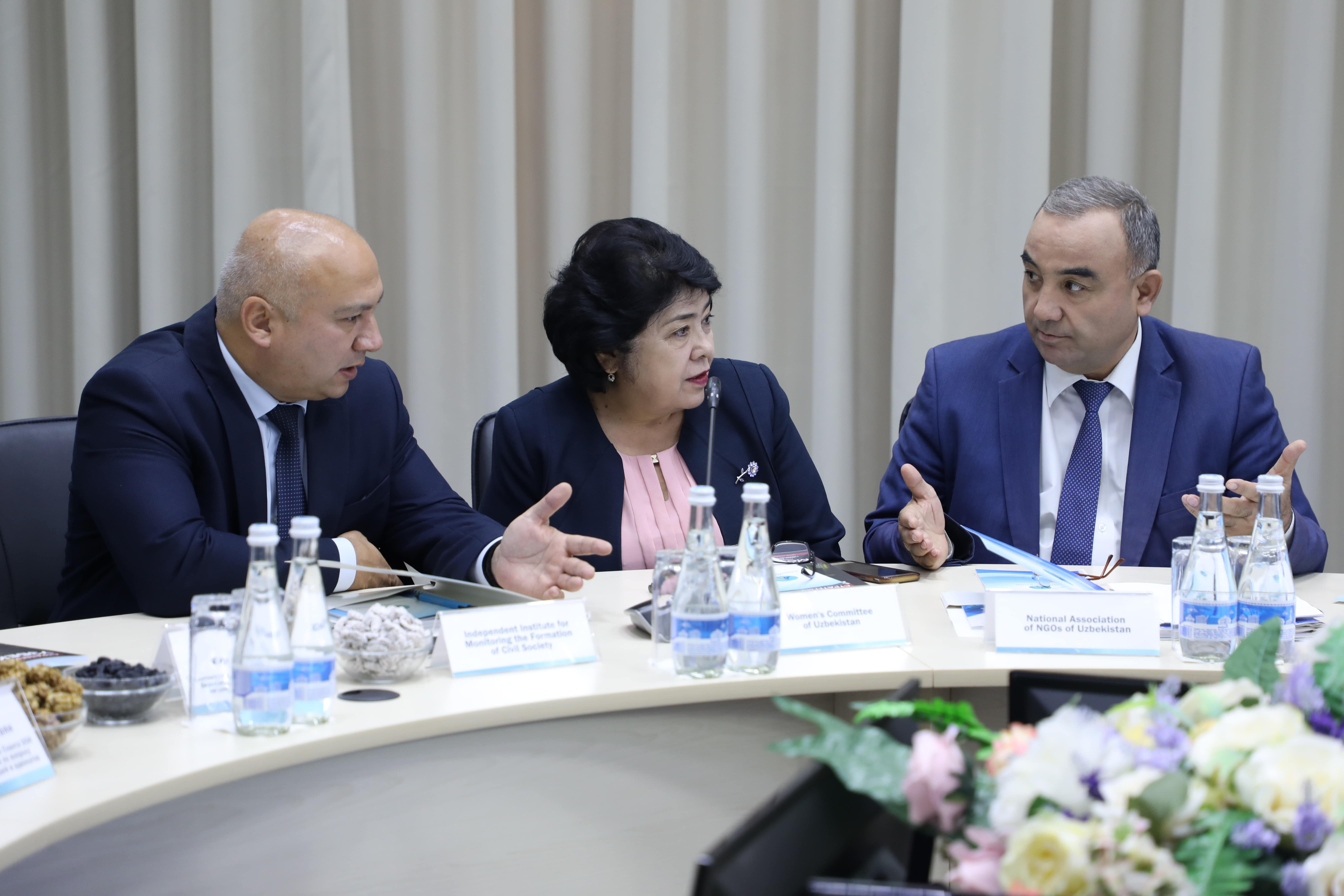
The Development Strategy Center has hosted a round-table discussion with the participation of the delegates on ‘Interaction of Civil Society Institutions with the Judiciary: Practices and Prospects’.
Along with members of the delegation of the UN Human Rights Council led by Diego Garcia-Sayan, Special Rapporteur on the Independence of Judges and Lawyers, the event was attended by senior officials of the Development Strategy Center, representatives of the Women's Committee, Youth Union of Uzbekistan, IIMFCS, Federation of Trade Unions of Uzbekistan, Madad, Istikbolli Avlod NGOs, Association of Persons with Disabilities of Uzbekistan, and other leading civil society institutions, as well as media workers.
Head of the Development Strategy Center Eldor Tulyakov opened and moderated the discussion.
In his opening remarks, he pointed out to the fact that the National Action Strategy on Five Priority Development Areas 2017-2021 set important tasks to increase the role and importance of civil society institutions, the reliable protection of the legitimate rights of citizens, while achieving the rule of law in the activities of judges, which are being consistently implemented.
The Development Strategy Center, jointly with the Supreme Court and other law enforcement agencies, has been taking action to improve the judicial area.
Along with that, sociological polls and surveys are held among the population. Public opinion is being shaped, as proved by a range of projects organized by several partner organizations, for instance, a comprehensive discussion of the situation in the country on forced and child labor in a training organized for the media, as well as the Center’s engagement in the organization and conduct of the international conference on ‘Administrative Proceedings in the Republic of Uzbekistan: Current State and Development Prospects’. The Development Strategy Center has been consistently maintaining effective cooperation between the judiciary and non-governmental non-profit organizations.
Eldor Tulyakov introduced the guests into the results of the abovementioned collaboration by the example of the activities of the Women's Committee of Uzbekistan, Youth Union, and local self-government bodies. These structures have been entitled to bail women and youth in court under their guarantee.
As a result, in the framework of the memorandum signed between the Supreme Court and the Women’s Committee of Uzbekistan on July 20, 2018, women are bailed out of imprisonment, or the term of serving their sentences is reduced.
In six months of this year alone, the punishment for 227 women has been mitigated. 51 women were conditionally discharged, 131 women were sentenced to non-custodial sentences under the guarantee of the Women’s Committee.
In turn, in the first half of 2019, citizens’ assemblies have held 12,334 field meetings, 440 citizens were taken under the guarantee of territorial councils of citizens' assemblies. Certain measures are being taken in this area under the memorandum signed between the Youth Union and the Supreme Court of the Republic of Uzbekistan.
Executives of the Madad and Istikbolli Avlod NGOs and the Association of Persons with Disabilities of Uzbekistan took floor at the meeting and introduced the guests to the ongoing policies and projects.
In turn, Diego Garcia-Sayan drew attention to fundamental changes that have taken place in Uzbekistan over the past three years in general, and in the field of human rights in particular, and expressed his positive attitude.
According to the guest, it is very important that, owing to the efforts of the Women's Committee, several women were acquitted, released, or their sentences were mitigated, which proves certain progress in the judicial sector. 2016 marked six acquittals, while last year there were 867 of them, and since the beginning of this year more than 500 people have been acquitted. All this happens in real life, suggesting that judges make independent decisions.
The participants expressed views on the ongoing reforms in the sector and their practical outcomes, and broadly discussed long-term objectives.
Information Service, Development Strategy Center
 English
 Русский
 О'zbek



As is known, a delegation of the UN Human Rights Council, headed by Diego Garcia-Sayan, Special Rapporteur on the Independence of Judges and Lawyers, is visiting Uzbekistan these days.
The Development Strategy Center has hosted a round-table discussion with the participation of the delegates on ‘Interaction of Civil Society Institutions with the Judiciary: Practices and Prospects’.
Along with members of the delegation of the UN Human Rights Council led by Diego Garcia-Sayan, Special Rapporteur on the Independence of Judges and Lawyers, the event was attended by senior officials of the Development Strategy Center, representatives of the Women's Committee, Youth Union of Uzbekistan, IIMFCS, Federation of Trade Unions of Uzbekistan, Madad, Istikbolli Avlod NGOs, Association of Persons with Disabilities of Uzbekistan, and other leading civil society institutions, as well as media workers.
Head of the Development Strategy Center Eldor Tulyakov opened and moderated the discussion.
In his opening remarks, he pointed out to the fact that the National Action Strategy on Five Priority Development Areas 2017-2021 set important tasks to increase the role and importance of civil society institutions, the reliable protection of the legitimate rights of citizens, while achieving the rule of law in the activities of judges, which are being consistently implemented.
The Development Strategy Center, jointly with the Supreme Court and other law enforcement agencies, has been taking action to improve the judicial area.
Along with that, sociological polls and surveys are held among the population. Public opinion is being shaped, as proved by a range of projects organized by several partner organizations, for instance, a comprehensive discussion of the situation in the country on forced and child labor in a training organized for the media, as well as the Center’s engagement in the organization and conduct of the international conference on ‘Administrative Proceedings in the Republic of Uzbekistan: Current State and Development Prospects’. The Development Strategy Center has been consistently maintaining effective cooperation between the judiciary and non-governmental non-profit organizations.
Eldor Tulyakov introduced the guests into the results of the abovementioned collaboration by the example of the activities of the Women's Committee of Uzbekistan, Youth Union, and local self-government bodies. These structures have been entitled to bail women and youth in court under their guarantee.
As a result, in the framework of the memorandum signed between the Supreme Court and the Women’s Committee of Uzbekistan on July 20, 2018, women are bailed out of imprisonment, or the term of serving their sentences is reduced.
In six months of this year alone, the punishment for 227 women has been mitigated. 51 women were conditionally discharged, 131 women were sentenced to non-custodial sentences under the guarantee of the Women’s Committee.
In turn, in the first half of 2019, citizens’ assemblies have held 12,334 field meetings, 440 citizens were taken under the guarantee of territorial councils of citizens' assemblies. Certain measures are being taken in this area under the memorandum signed between the Youth Union and the Supreme Court of the Republic of Uzbekistan.
Executives of the Madad and Istikbolli Avlod NGOs and the Association of Persons with Disabilities of Uzbekistan took floor at the meeting and introduced the guests to the ongoing policies and projects.
In turn, Diego Garcia-Sayan drew attention to fundamental changes that have taken place in Uzbekistan over the past three years in general, and in the field of human rights in particular, and expressed his positive attitude.
According to the guest, it is very important that, owing to the efforts of the Women's Committee, several women were acquitted, released, or their sentences were mitigated, which proves certain progress in the judicial sector. 2016 marked six acquittals, while last year there were 867 of them, and since the beginning of this year more than 500 people have been acquitted. All this happens in real life, suggesting that judges make independent decisions.
The participants expressed views on the ongoing reforms in the sector and their practical outcomes, and broadly discussed long-term objectives.
Information Service, Development Strategy Center