
Nilufar NODIRXONOVA,
Development Strategy Centre
Head of Department
It is no coincidence that the Strategy of Action for the Development of the Republic of Uzbekistan for 2017-2021, initiated by the President of the Republic of Uzbekistan Shavkat Mirziyoyev, identifies the rule of law and further reform of the judicial system as a second priority. Indeed, in the radical modernization of the state and society, first of all, reliable protection of the rights and freedoms of citizens, ensuring the independence of the judiciary, access to justice, strengthening the rule of law, effective fight against corruption are of high importance. Over the past period, Uzbekistan, along with all other sectors, has carried out large-scale work in this direction.
It is well known that it is the right of every person to demand an independent and impartial court. This right is enshrined in Article 10 of the Universal Declaration of Human Rights and other international instruments to which the Republic of Uzbekistan has acceded. Only an independent court can give confidence that every citizen can defend his or her violated rights through an impartial and transparent trial. In this regard, the reforms implemented on the basis of the Strategy of Action have laid the foundation for the democratization and liberalization of the judiciary, ensuring true independence of the judiciary, protection of the rights and legitimate interests of citizens.
As noted in the next Address of the President of the Republic of Uzbekistan to the Oliy Majlis on December 29, 2020 [1], over the past 4 years, bold steps have been taken to reform the judiciary. More than 40 laws, decrees and decisions have been adopted on priority issues in this area. An important strategic step has been taken to ensure the rule of law and further reform the judiciary.
In particular, the Supreme Council of Judges was established to ensure the independence of the judiciary. Also, the Supreme Court and the Supreme Economic Court were unified and the activity of the Supreme Court was improved. The arbitration courts in the regions were reorganized into economic courts, and 71 inter-district, district (city) economic courts were empowered to hear cases in the first instance. The term of office of a judge was identified as five years for the first time, then ten years and afterwards - indefinite. The powers of the courts to independently resolve their financial, material and technical issues were transferred from the judiciary to the Supreme Court. The institution of returning the criminal case for further investigation by court is abolished. It was firmly established that a person's guilt in committing a crime was based solely on the evidence found in the trial. Torture, mental, physical, and other forms of violence were strictly prohibited.
In order to further strengthen human rights guarantees in court proceedings and to implement the principle of adversarial nature of the parties, there was introduced the institute of preliminary hearings in criminal courts [2]. For the sake of transparency and openness of the courts, more than 10,000 criminal cases were considered in mobile court hearings. The maximum periods of detention - as a precautionary measure and of preliminary investigation were reduced.
It should be noted that a mechanism for the selection of candidates for judicial office has been introduced. For the first time, the practice of online coverage of the examination process for the selection of candidates for the post of judge has been established [3]. Consideration of candidates to be appointed for the position of a judge for the first time will be carried out on an alternative basis. Of course, the new system of training qualified and mature judges and court staff will serve to increase public confidence in the judiciary, ensure the stability of justice and the rule of law, literally turn the court into a "fortress of justice" and achieve a high level of justice.
Also, investment disputes and competition cases will be heard only by economic courts. The right of prosecutors to participate in all economic court hearings was abolished. From now on, the prosecutor can participate only in cases provided by law or in cases initiated by the prosecutor's statement of claim [4].
Another noteworthy aspect is that the supervisory instance in the proceedings has been abolished. The principle of "one court - one instance" was introduced in the judiciary through the abolition of red tape, as well as the practice of reviewing the decisions of inter-district courts by regional courts, and decisions of regional courts as courts of first instance by the Supreme Court of the Republic of Uzbekistan.
The institution of conciliation was introduced on the confession of guilt. It is an important factor in the implementation of criminal, criminal procedure legislation in the country, raising to a higher level the protection of human rights, freedoms and legitimate interests.
The right of the Prosecutor General and his deputies to protest against court decisions in a supervisory order was also revoked. Clear criteria have been put into practice (rating program) that provide an open and transparent assessment of the effectiveness of judges through electronic rankings. The establishment of a judicial inspectorate to ensure the inviolability of judges and the prevention of corruption serves to ensure the inviolability of judges. If the public prosecutor dropped the charge, the criminal case would be terminated on the grounds of rehabilitation [5].
Today, a number of measures are being taken to ensure gender equality in the judiciary, increase the status of women in the judiciary, especially to support women judges. In particular, in 2019 – there have been 149 women judges, in 2020 this figure reached 157. In the I quarter of 2021, there were 1,053 male judges out of a total of 1,214 judges in the country, with 161 female judges, or 15.3 per cent. Out of a total of 63 judges in the Supreme Court, 15 are female (31.25%).
For the first time in the history of Uzbekistan, a system of appealing against the decisions and illegal actions of state bodies and officials has been established. This system, created to ensure the implementation of constitutional law, began to bear fruit in a short time. For example, between 2019 and 2020, 31,321 applications were considered by administrative courts, of which 21,272 or almost 67.9% were satisfied. In particular, 2,852 decisions of governors were declared illegal and the violated rights of citizens and legal entities were restored.

Over the past four years, 2,770 people have been acquitted, while in 2020 alone, 781 people have been acquitted, 3,434 people have been released from the courtroom, and in cases of 5,958 people unjustified charges were dropped or changed. This is undoubtedly one of the great achievements in the field of justice.
It should be noted that the penal colony "Jaslyk", which has long been a symbol of the country, has been abolished. The closure of this institution was a great event in the political life of the country and in the eyes of the world community. The reduction of the number of prisoners in prisons by 2.5 times is also an important step in the protection of human rights.
Customs reforms are in full swing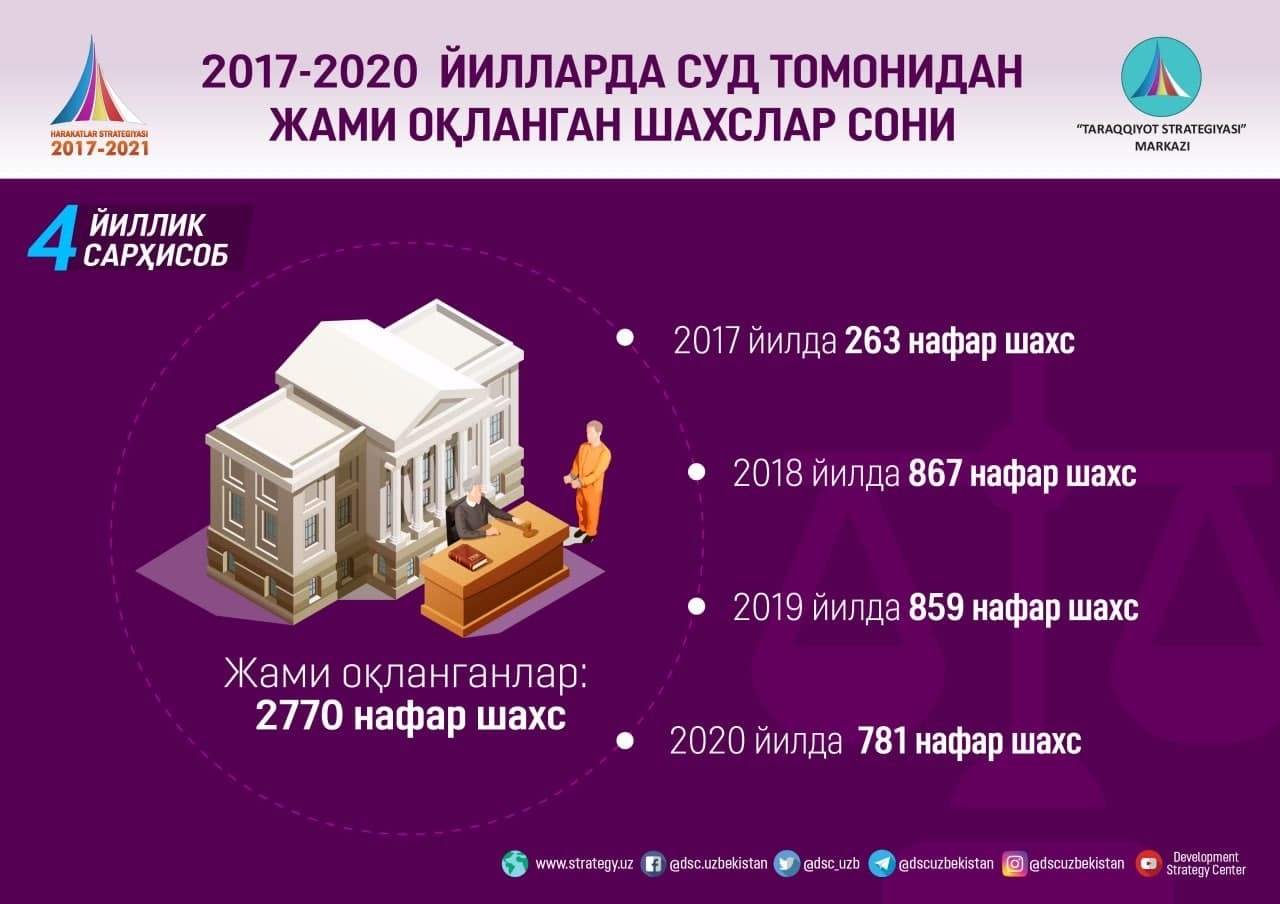
It should be noted that in order to reliably protect the rights and freedoms of citizens, the practice of "green" and "red" corridor system for individuals to enter and leave the customs territory has been established. Before the introduction of the "green corridor", it took an average of 2 hours for a passenger to pass customs control when entering the Republic of Uzbekistan, but now passengers leave the border and customs control in an average of 30 minutes to 1 hour.
Reforming the propiska system is a historic step
As a result of the reforms, the "propiska" system, which has been a painful issue for the population for many years, has been radically reformed [6], important steps have been taken to protect human rights and interests. The new version of the Law of the Republic of Uzbekistan "On Citizenship of the Republic of Uzbekistan" [7] was adopted in order to ensure granting citizenship of the Republic of Uzbekistan to stateless persons and ensuring that these persons also fully exercise their political rights and participate in the election process as state citizens. As a result, about 50,000 stateless persons permanently residing in the country will receive citizenship of the Republic of Uzbekistan. In considering the issues in this regard, it is planned to follow the mechanisms of interdepartmental electronic cooperation [8].
Also, for the convenience of our people, the registration of citizens for permanent residence and temporary residence is carried out on the basis of the "single window" principle through the “Manzil” (“Address”) program of the Ministry of Internal Affairs.
Protecting human rights is the main goal
It should be noted that, from a humanitarian point of view, restrictions on the right of juvenile prisoners to meet their relatives have been lifted, special arrangements have been made for women prisoners to meet with their children, and the number of meetings and telephone conversations has been increased.
In October 2020, for the first time in the history of the national statehood of Uzbekistan, the country was elected a member of one of the main bodies of the United Nations - the Human Rights Council. It is an international recognition that human rights and freedoms are guaranteed in the country. The US State Department has announced that Uzbekistan has been removed from the Special Watch List for religious freedom. To achieve this result, Uzbekistan has conceptually reconsidered approaches to the implementation of measures to combat extremism. In particular, more than 20,000 citizens were removed from the "special lists".
The fact that the amnesty system has been established and consistently pursued by the head of state is a proof that the reforms being carried out in the country are in full compliance with the principles of humanity. In particular, in 2017-2020, amnesty acts were applied to about 5,000 convicts serving their sentences. During this period, the mitigation measures were applied to 67.4 thousand convicts with positively classified behaviour. In particular, in 2020 alone, the President signed 5 relevant decrees in this regard. As a result, 616 prisoners were pardoned. Of those pardoned, 274 were released on parole, the sentences of 237 people were reduced, and the sentences of 76 people were commuted to lighter sentences. Of those pardoned, 87 were women, 29 were foreign nationals, and 290 were members of banned organizations.
Fighting corruption is a requirement of today
For the first time in Uzbekistan, the Law on Combating Corruption [10] was adopted to improve the system of combating crime and crime prevention. According to the law, there is established the Anti-Corruption Agency, and the fight against corruption to be carried out in an institutional and systematic manner. One of the main tasks of the Agency is to conduct an in-depth analysis of areas with high levels of corruption and to eliminate the causes and conditions for the commission of corruption-related offenses. The Agency compiles the National Anti-Corruption Report, which must be published annually in the media. It controls the achievement of full compensation for damage caused to society and the state as a result of corruption crimes [11].
Uzbekistan's place and prestige in the international arena
In this regard, it is worth recalling the words of President Sh. Mirziyoyev: "Justice is a solid foundation of statehood." Indeed, the reforms being carried out in all spheres of the country today, the democratic changes are taking place in an irreversible manner. This, in turn, is recognized by the international community.
In particular, according to the Rule of Law index, in 2019 Uzbekistan ranked 94th out of 128 countries, and in 2020 - 92nd.
In terms of "safety and security", Uzbekistan has the best result, ranking ninth, along with Canada, the UAE and Hungary.
Also, in the Corruption Perceptions Index for 2019, published by Transparency International in 2020, Uzbekistan ranked 153rd out of 180 countries with 25 points, rising 5 places. In 2018, the indicator was 158th with 23 points.
It is obvious that strategic steps are being taken in New Uzbekistan to ensure the rule of law, to reform the judicial system, to protect the rights and interests of citizens which is a priority part of the reforms. Undoubtedly, these radical changes are an expression of the practical work being done in the interests of the people.
References:
[1] Ўзбекистон Республикаси Президентининг расмий веб-сайти 29.12.2020 й., Электрон манба: https://president.uz/uz/lists/view/4057.
[2] Ўзбекистон Республикасининг «Жиноят ишлари бўйича суд қарорларини қайта кўриш институти такомиллаштирилиши муносабати билан Ўзбекистон Республикасининг жиноят-процессуал кодексига ўзгартиш ва қўшимчалар киритиш тўғрисида»ги Қонуни. Қонун ҳужжатлари маълумотлари миллий базаси, 13.01.2021 й., 03/21/664/0014-сон., Электрон манба: https://lex.uz/docs/5213898.
[3] Ўзбекистон Республикаси Президентининг «Судьяларнинг чинакам мустақиллигини таъминлаш ҳамда суд тизимида коррупциянинг олдини олиш самарадорлигини ошириш чора-тадбирлари тўғрисида»ги Фармони. Қонун ҳужжатлари маълумотлари миллий базаси, 07.12.2020 й., 06/20/6127/1609-сон., Электрон манба: https://lex.uz/docs/5146554.
[4] Ўзбекистон Республикасининг «Суд қарорларини қайта кўриш институти такомиллаштирилиши муносабати билан Ўзбекистон Республикасининг иқтисодий процессуал кодексига ўзгартиш ва қўшимчалар киритиш тўғрисида»ги Қонуни. Қонун ҳужжатлари маълумотлари миллий базаси, 13.01.2021 й., 03/21/663/0013-сон., Электрон манба: https://www.lex.uz/docs/5214169.
[5] Ўзбекистон Республикасининг «Жиноят ишлари бўйича суд қарорларини қайта кўриш институти такомиллаштирилиши муносабати билан Ўзбекистон Республикасининг жиноят-процессуал кодексига ўзгартиш ва қўшимчалар киритиш тўғрисида»ги Қонуни. Қонун ҳужжатлари маълумотлари миллий базаси, 13.01.2021 й., 03/21/664/0014-сон., Электрон манба: https://lex.uz/docs/5213898.
[5] Ўзбекистон Республикасининг «Тошкент шаҳри ва Тошкент вилоятида доимий яшаш жойи бўйича рўйхатга олиниши лозим бўлган шахслар – Ўзбекистон Республикаси фуқаролари тоифаларининг рўйхати тўғрисида»ги Қонуни. Қонун ҳужжатлари маълумотлари миллий базаси, 14.05.2020 й., 03/20/616/0580-сон., Электрон манба: https://www.lex.uz/acts/1869805.
[6] Ўзбекистон Республикасининг «Ўзбекистон Республикасининг фуқаролиги тўғрисида»ги Қонуни, Қонун ҳужжатлари маълумотлари миллий базаси, 14.03.2020 й., 03/20/610/0299-сон., Электрон манба: https://lex.uz/ru/docs/4761986.
[7] Ўзбекистон Миллий ахборот агентлиги (2020), «Ўзбекистон Республикаси Олий Мажлиси Сенати иккинчи ялпи мажлиси тўғрисида». Электрон манба: https://uza.uz/uz/posts/zbekiston-respublikasi-oliy-mazhlisi-senati-ikkinchi-yalpi-m-28-02-2020.
[8] «Ўзбекистон Республикаси Президентининг «Озодликдан маҳрум этиш жазосини ўтаётган, қилмишига чин кўнгилдан пушаймон бўлган ва тузалиш йўлига қатъий ўтган бир гуруҳ шахсларни афв этиш тўғрисида»ги Фармонига шарҳ». Электрон манба: https://president.uz/uz/lists/view/3347.
[9] Ўзбекистон Республикасининг «Коррупцияга қарши курашиш тўғрисида»ги Қонун. Қонун ҳужжатлари маълумотлари миллий базаси, 16.01.2019 й., 03/19/516/2484-сон; 24.05.2019 й., 03/19/542/3177-сон, 2019 й., 2-сон, 47-модда; Қонунчилик маълумотлари миллий базаси, 21.04.2021 й., 03/21/683/0375-сон., Электрон манба: https://lex.uz/docs/3088008.
[10] Ўзбекистон Республикаси Президентининг «Ўзбекистон Республикаси коррупцияга қарши курашиш агентлиги фаолиятини ташкил этиш тўғрисида»ги Қарори. Қонун ҳужжатлари маълумотлари миллий базаси, 30.06.2020 й., 07/20/4761/1001-сон., Электрон манба: https://lex.uz/docs/4875782.
[11] «Ўзбекистоннинг халқаро рейтинглардаги кўрсаткичлари». Электрон манба: https://strategy.uz/index.php?category=infog.
 English
 Русский
 О'zbek


