Jamshid Sharipov
Head of the Department of the “Development  Strategy” Center
Ramzidin Nuridinov
Chief Specialist of the “Development Strategy" Center
The development of artificial intelligence and digital technologies in Uzbekistan is actively supported by the state. To this end, there was adopted the Resolution of the President of the Republic of Uzbekistan No. PP-4996 “On Measures to Create Conditions for the Accelerated Implementation of Artificial Intelligence Technologies” as of February 17, 2021, aimed at creating a favourable environment for the development of technologies based on artificial intelligence (AI).
In order to train highly qualified specialists in such areas as artificial intelligence, information security, data protection, digital economy, and robotics industry, it was created a Cyber University. In addition, starting from the 2023/2024 academic year, 572 students were admitted to study in the field of artificial intelligence at 12 higher educational institutions of the country, of which 510 were admitted to bachelor's programs and 62 to master's programs.
In order to further introduce artificial intelligence technologies into the social sphere and sectors of the economy, there was approved the Strategy for the Development of Artificial Intelligence Technologies until 2030[1], which defines the key directions and priorities in this area for the long term.
Problems and challenges
Despite positive changes in the development of digital technologies and the personnel training system, education in Uzbekistan continues to face a number of challenges that require a comprehensive approach and modernization. In particular:
I. Insufficient integration of innovative technologies into the educational process. In most educational institutions, the use of digital tools and interactive platforms is limited, which reduces learning effectiveness and prevents students from developing digital literacy. As a result, schoolchildren are not sufficiently prepared for modern challenges related to technological progress.
This problem is especially acute in rural schools, where access to computers, the internet, and modern educational programs remains limited, for example, in 2022, more than 30% of rural schools in the country did not have stable access to the internet[2].
According to UNICEF study, only 40% of school-going children could work on a computer, and only 37% had basic digital literacy. In rural areas, the situation is even more complicated - less than 30% of children knew how to use digital devices. This indicates a serious digital inequality that puts rural schoolchildren in a priory unfavourable position compared to their urban peers[3].
In addition, the low level of digitalization of the educational process is reflected in the quality of training teachers themselves. Many educators lack sufficient experience working with modern educational platforms, which limits their ability to apply advanced teaching methodologies.
II. The lack of qualified teachers remains one of the most serious problems in the education system of Uzbekistan. This challenge is impacting not only the quality of students' knowledge but also their future, affecting the country's development in scientific, technological, and social spheres.
The President of Uzbekistan Shavkat Mirziyoyev, at the meeting on August 28, 2023, dedicated to priority tasks for improving the quality of education, increasing the number of school places, and supporting teachers, expressed concern about the level of training of pedagogical personnel. He noted that the knowledge and skills of 86 thousand out of 220 thousand teachers - that is, 37% - were assessed as “unsatisfactory”[4].The situation with teachers of computer science, English, physics, mathematics, and chemistry - subjects that are the foundation of modern education - is particularly alarming. Without the high-quality teaching of these subjects, it is impossible to raise a generation capable of critical thinking, creating innovations, and solving complex scientific and technological problems that determine the future of society.
III. Outdated teaching programs that do not meet the requirements of the labour market hinder the development of critical thinking and key skills in students. It does not take into account advanced educational practices and new approaches to learning. In this regard, on October 30, 2020, during the meeting on improving the education and upbringing system, accelerating the development of science in the country, President Shavkat Mirziyoyev noted: “If the methodology of teaching in schools is not changed, neither the quality of education, nor its content, nor the environment will change”[5]. emphasizing the need for fundamental changes.
A year and a half later, on April 5, 2022, at the meeting on analysis of the reforms in the field of public education, the President once again drew attention to this problem, noting that outdated approaches to teaching remain a serious obstacle[6]. He also pointed out the lack of initiatives to introduce advanced technologies in schools and provided specific data: it was revealed that in 852 schools of the country, the indicators of the quality of education, potential of teachers, and admission of graduates to universities are extremely low.
Recommendations and suggestions
The current global trends in digitalization and artificial intelligence require the education system not only to adapt but also to proactively implement advanced technologies. International experience shows that the successful integration of AI into the educational process allows not only to improve the quality of knowledge but also to eliminate the digital divide, develop critical thinking, and train competitive personnel.
In order to solve the identified problems and effectively achieve the priority tasks of the “Uzbekistan – 2030” Strategy on modernization of education, experts of the “Development Strategy” Center developed the following proposals:
First, for the successful and safe integration of artificial intelligence into the educational process, it is necessary to establish clear legal frameworks regulating the use of AI in education, with an emphasis on ethical aspects and the protection of personal data of students and teachers.
According to the SoSafe Cybercrime Trends 2025 report, 87% of organizations worldwide were subjected to cyberattacks using AI last year. This lays emphasis on the growing threat and the need for effective digital security measures at state level[7].
In response to such challenges, in April 2024, the European Union adopted the world's first law regulating the use of AI systems to reduce risks associated with them. The law introduces a four-level classification of risks - from minimal to unacceptable - with the phased implementation of relevant requirements for each level.
It is also important to ensure the implementation of mechanisms for monitoring and reliable protection of personal data, including in educational institutions, including mandatory certification of artificial intelligence systems in accordance with international standards, similar to the General Data Protection Regulation (GDPR) in effect in the European Union.
To apply European experience, Uzbekistan should develop a national certification standard for AI systems in education, focusing on GDPR norms and adapting them to local legislation.
The EU's General Data Protection Regulation (GDPR), considered the world's strictest law on privacy and security, requires strict adherence to standards, and the existence of a GDPR certificate confirms that an organization, product, or service meets these requirements[8].
As a result of the implementation of GDPR, 31% of clients already in 2019 noted positive changes in trust in technologies, including AI-based ones, and in the UK, 62% more consumers have become more willing to share personal data.
Also, in response to GDPR requirements, 73% of European companies improved customer information management, 62% increased investments in cybersecurity, and revised data collection and storage approaches to comply with standards and improve transparency[9].
Second, to revise school and university curricula, supplementing subjects in computer science and information technology with modern areas such as programming fundamentals, robotics, and artificial intelligence, — with an emphasis on practice-oriented learning, following the example of Malaysia's #MyDigitalMaker initiative. At the same time, it is necessary to develop technological hubs based on educational institutions, providing them with computer equipment and stable internet access, especially in rural areas, where about 30% of schools still do not have reliable connections.
A program similar to #MyDigitalMaker can be launched in Uzbekistan in three phases. At the first phase, it is necessary to start with a pilot project in 100 schools with the creation of the first technology hubs, where training modules will be tested, taking into account international experience, including the elements of #MyDigitalMaker. The courses should be practice-oriented and include working with real AI-based technologies. In the second phase, the program should be expanded to 1,000 schools, and in the third phase, it should be scaled to the entire country. According to international experts, every dollar invested in IT education brings up to $10 to the country's economy.
The MyDigitalMaker initiative, launched in Malaysia in August 2016, aims to transform young people from ordinary users of digital technologies into active developers and participants in the digital economy.
By 2024, nearly 2.5 million Malaysian schoolchildren participated in the #Mydigitalmaker initiative thanks to the integration of programming and computational thinking into the curriculum, as well as through extracurricular activities held in more than 70 Digital Maker Hubs. The program contributed to students’ international achievements: in 2023, Malaysia entered the top 10 at the International Scratch Olympiad and won gold at the International Youth Robotics Competition in South Korea. Also, at SECASO-2024 in Vietnam, Malaysian students won two gold, two silver, and four bronze medals[10].
Third, to develop a national teacher training program based on the Malaysian Cikgu Juara Digital (CJD) initiative, focused on developing digital literacy. The program will cover training in working with digital platforms, AI technologies, and modern teaching methods adapted to the digital environment. After the training, participants will be able to conduct seminars and trainings for colleagues, disseminating their knowledge in the professional community.
In the context of Uzbekistan, it is advisable to send graduates of this program to schools experiencing personnel or methodological difficulties, especially in rural areas or educational institutions with low university admission rates, so that they can share their experience and contribute to the professional development of other teachers. This program is relevant given the data announced by the President, according to which 37% of teachers (220 thousand out of 86 thousand) demonstrated insufficient skill level.
Cikgu Juara Digital (CJD) — Malaysian national program aimed at developing teachers’ digital competencies and preparing them for the digital transformation of education. Within the framework of this initiative, 356 teachers were trained, who taught more than 24,000 schoolchildren the basics of artificial intelligence and data science. In addition, program participants conduct training sessions for colleagues in computational thinking, programming, and other IT areas, forming a professional community capable of implementing digital technologies in the educational process[11].
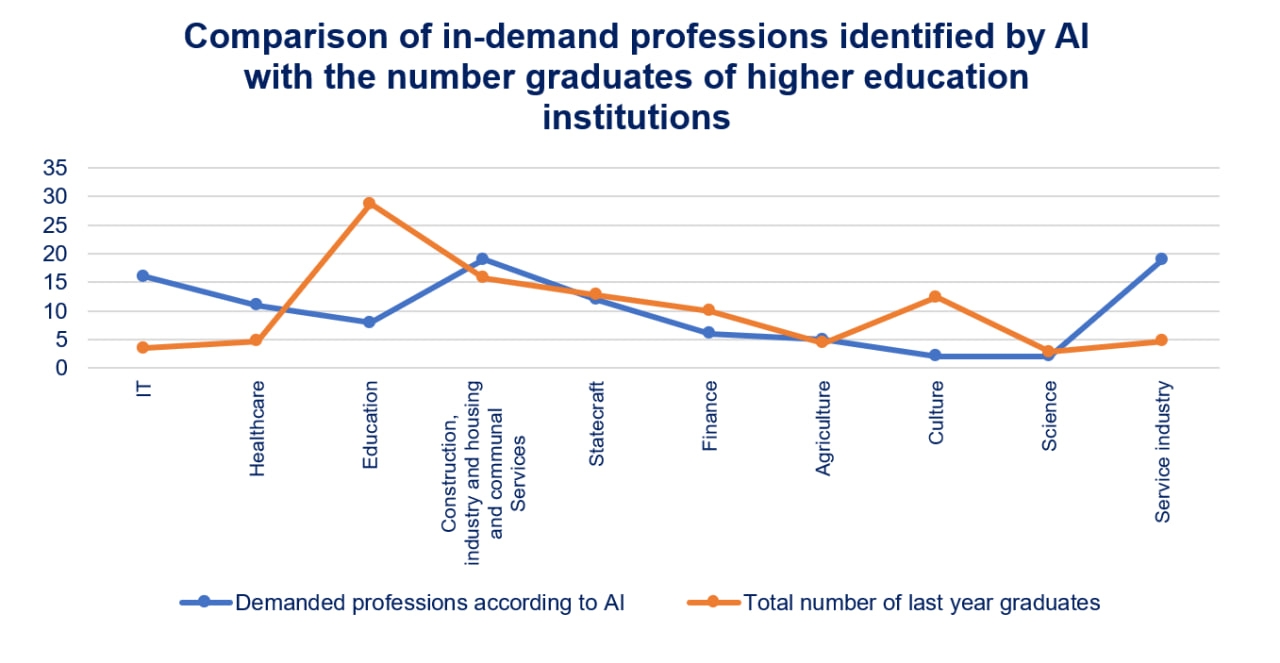
As an example, we can cite the pilot analysis conducted by experts from the “Development Strategy” Center using artificial intelligence technologies. As a result, the most demanded professions in Uzbekistan were identified, and when compared with the data on graduates, it was revealed that there is a shortage of IT personnel and an excess in the education sector. This confirms the need to adjust educational programs with orientation to the labour market.
The University of Helsinki demonstrates one of the best employment rates among Finnish universities. According to the survey conducted at the end of 2023 among 2018 graduates with a master's degree, as well as a bachelor's degree in pharmaceuticals and preschool education, 94% of them found jobs within five years of graduation. Among the 2020 doctoral graduates, the job placement rate reached 96%, which indicates a high demand for academic personnel. At the same time, 87% of students noted that they apply university knowledge in their professional activities, and 83% believe that their current job corresponds to the education received[12].
Fifth, to develop a national digital platform for personalized learning similar to the British CENTURY Tech for teaching mathematics, English, and natural sciences from the 5th grade, as well as tools for lesson planning, which will allow reducing the workload on teachers and ensuring flexible adaptation of learning materials to the individual needs of students.
CENTURY Tech — British educational platform that integrates artificial intelligence with pedagogy and neuroscience for personalized learning: it tracks students' achievements and shortcomings, automatically forms assignments, or provides tools for teachers to assign them. According to research, its use increases the level of understanding of educational material by approximately 30%, and also reduces the administrative burden on teachers by an average of 6 hours per week, allowing them to focus on teaching and motivating pupils.
It is also assumed that it is worth studying the issue of the phased implementation of VR/AR technologies and virtual laboratory platforms similar to Labster for conducting school experiments in physics, chemistry, and biology. This is especially relevant considering that at the meeting in 2020, President Sh. Mirziyoyev noted that only 10% of teaching time is allocated for practical classes in natural science subjects in Uzbekistan's schools, while in developed countries it is between 30% and 50%.
The introduction of VR/AR technologies in Uzbekistan is relevant against the backdrop of a significant shortage of educational and laboratory equipment in schools, where 683 physics, 897 chemistry, and 901 biology classrooms are not fully equipped with the necessary equipment, and another 7,807 physics, 7,776 chemistry, and 7,770 biology classrooms have outdated equipment[13].
At the same time, the use of VR/AR technologies is an economically advantageous solution, as a one-time investment in digital educational tools allows for a significant reduction in the costs of acquiring, maintaining, and updating expensive laboratory equipment, as well as minimizing the costs of its repair and replacement, under conditions of limited budget and resources.
Labster — 3D learning software in the USA, offering interactive virtual laboratories in STEM disciplines that immerse students in a realistic scientific environment and contribute to a deeper understanding of the material. According to a 2023 study, the introduction of Labster into the biology course increased the proportion of students with A and B grades from 71% to 83% and increased interest in further studying STEM areas using the platform at the initial stages of training fivefold.
In addition, the transition to virtual laboratories, for example, in the chemistry course, allowed for a 12% reduction in costs by reducing downtime and increasing the number of training sessions[14].
[8] https://gdpr.eu/article-42-data-protection-certification/
[9] https://www.privacyengine.io/gdpr-statistics-worldwide-2024/#download-gdpr-global-statistics-for-2024
[10] https://mdec.my/ms/mydigitalmaker#mydigitalmaker_intro
[11] https://www.malaysianwireless.com/2025/02/gobind-malaysia-strategy-ai-cybersecurity/
[12] https://www.helsinki.fi/en/news/university/university-helsinki-graduates-report-record-high-satisfaction-their-degrees-and-low-unemployment-rate#:~:text=The%20proportion%20of%20employed%20in,unemployed%20at%20all%20since%20graduation.
[14] https://www.labster.com/guides/4-ways-labster-helps-solve-higher-ed-challenges
 English
 Русский
 О'zbek


