Jamshid SHARIPOV, Head of the Department of the Development Strategy Centre
Ramzidin NURIDINOV, Chief specialist of theDevelopment Strategy Centre
Today, climate change is one of the most pressing problems facing humanity. According to The Lancet's “Human Health and Climate Change 2024” (The Lancet Countdown) report, the negative consequences of climate change are increasing year by year.
The Lancet Countdown is an international study that analyses the relationship between climate change and human health. It is prepared annually by more than 200 scientists and specialists and is recognized by the UN and the World Health Organization (WHO).
In 2024, the global temperature rose by 1.55°C, exceeding the limit of 1.5°C set by the Paris Agreement. Climate change is having a serious impact on the natural environment, physical and mental health of people, food security, production capacity, and lifestyle in general.
According to the research results, climate change is a serious problem, which leads to a 167% increase in mortality among people over 65 years of age, cardiovascular diseases and respiratory tract problems, a decrease in income by 835 billion US dollars due to the loss of 512.4 billion hours of working time among the working-age population around the world, and 3.33 million people die prematurely due to air pollution with PM2.5 particulate matters.
Consequences of climate change
According to The Lancet Countdown report, the main problems caused by climate change are:
According to a report prepared by UNICEF based on data analysis from 23 countries, in 2021 alone, approximately 377 children died due to rising air temperatures in Europe and Central Asia[1]. And in Uzbekistan, 91 percent of children, that is, about 9.5 million people, suffer from heat stress. It is estimated that by 2030, the country is at risk of becoming one of the ten countries most affected by climate change[2].
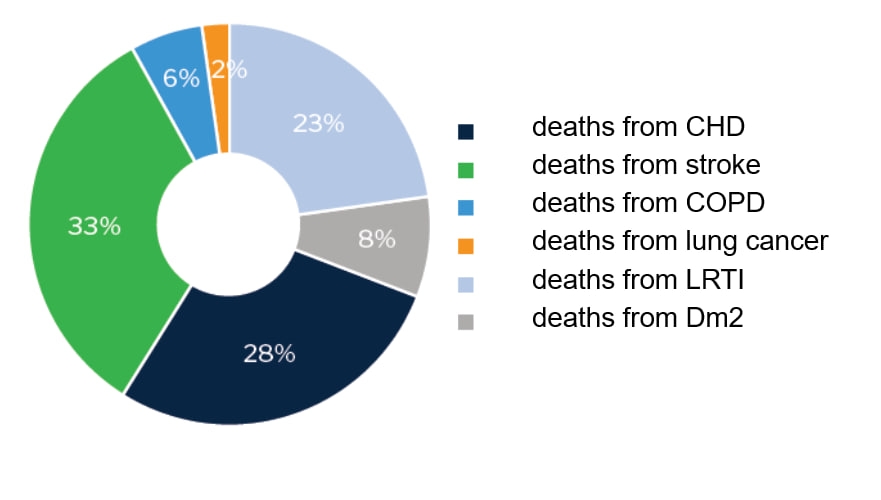
Also, in major cities of the republic, including Tashkent, the level of air pollution with PM2.5 particles significantly exceeds the norm and poses a serious threat to public health. In Tashkent alone, an average of 3,000 people dies every year. These deaths mainly occurred as a result of stroke, coronary heart disease, and lower respiratory tract infections (LRTI). According to the World Bank report, Uzbekistan ranks second in Central Asia in terms of PM2.5 concentration[3].
Annual PM2.5 pollution-related mortality in Tashkent, by cause of death[4]
In addition, due to the further increase in night-time temperatures caused by global warming and the sleep deprivation, every person loses up to 44 hours of sleep on average throughout the year. This situation is especially affecting women, the elderly, and the population of developing countries. It increases the risks of fever, heart attacks, mental disorders, and suicides, reduces working capacity, and increases the socio-economic vulnerability of the population[5].
Change in water availability as a result of expected population growth in 2050
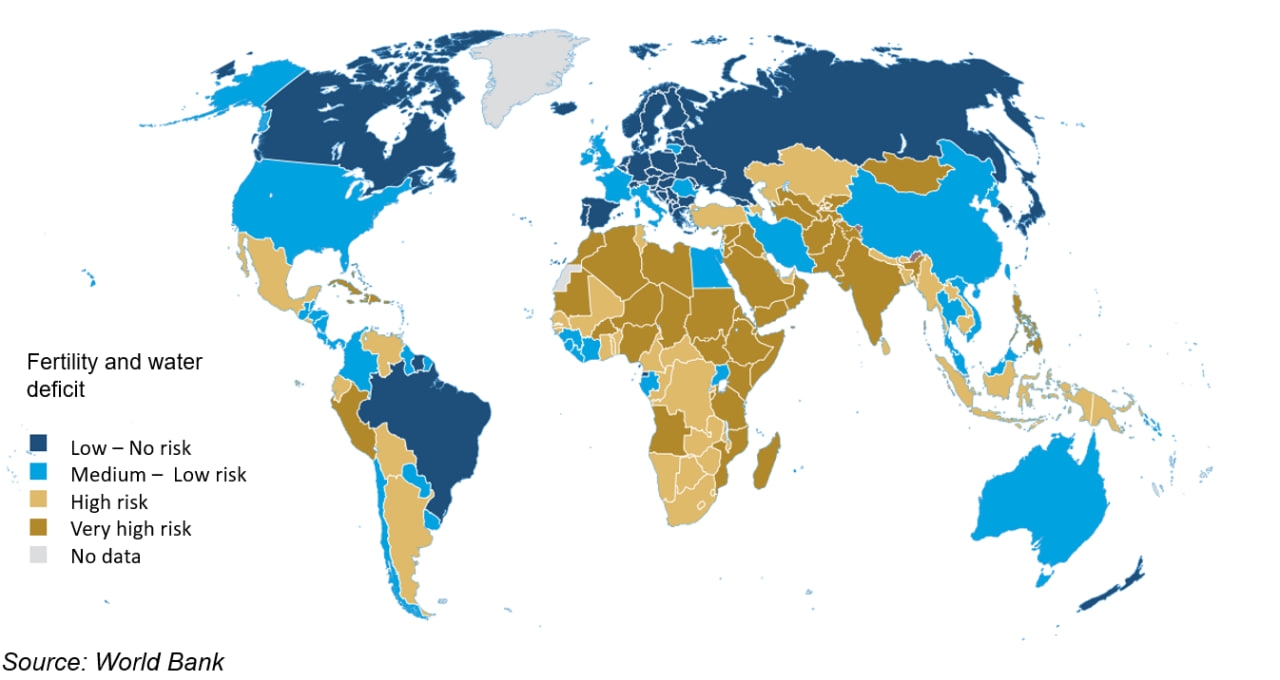
The figure above shows the change in water availability as a result of the expected population growth in 2050. It shows that even if climate change does not affect water resources, developing and arid regions of the world, including Uzbekistan, are seriously facing water shortage[7].
In addition, due to the arid climate of Uzbekistan, the irrigation system plays an important role in agriculture. The agricultural sector accounts for about 25% of GDP and employment. About 90% of water resources are spent on the agricultural sector, and the main water supply is carried out through the canal system through the Amudarya and Syrdarya rivers. Climate change - reduced glacial runoff, uncertainty in precipitation, and drought - can exacerbate water scarcity, reducing water reserves by 30-40% and increasing the need for irrigation by 25%, further exacerbating the country's dependence on water[8].
Also, in 2023, almost half of the Earth's surface (48 percent) experienced severe drought for at least a month, which was the second highest figure since 1951. Climate change caused by human intervention (anthropogenic) is causing droughts to occur more frequently and intensify[11]. According to the World Resources Institute, Uzbekistan ranks 25th among the countries with the most pronounced water shortages. Over the past decade, the frequency of drought conditions in the country have increased, especially in summer and autumn, affecting the region in lower reaches of the Amu Darya River and the Aral Sea[12].
Suggestions and recommendations for troubleshooting
Uzbekistan is implementing a number of measures aimed at reducing the negative consequences of climate change and environmental problems. In particular, the country adopted National Action Plan to reduce the risk of natural disasters and increase resilience to climate change for 2023-2030[13] and the Strategy for the transition to a “green” economy for 2019-2030[14]. Also, Green University was established to train specialists capable of solving the environmental problems of Uzbekistan and the Central Asian region, and a regional strategy for adapting to climate change in Central Asia began to be implemented.
However, the scale of the growing challenges posed by climate change and their rapid escalation may lead to a situation where existing measures are insufficient to achieve full effect.
Taking these into account, the experts of the Development Strategy Centre propose to implement the following measures:
Firstly, to effectively protect public health in the context of climate change, it is necessary to establish close cooperation between the structures of Uzhydromet and the Ministry of Health. Such integration allows for early risk identification and prevention of diseases that can occur in extreme weather conditions. As an example, one can mention the ‘heatwave plan’ (Le Plan Canicule) to combat abnormal heat in France, which operates annually from June 1 to September 15[15].
Le Plan Canicule – The heatwave alert system, coordinated by the French National Agency for Health (ANSP), is a warning system that considers not only temperature but also humidity levels, heat duration, environmental pollution, building density, and the load on medical facilities[16].
Also, in order to mitigate the impact of climate change on public health, it is important to regularly improve the qualification of primary healthcare workers, including deepening their professional knowledge, strengthening practical skills, and improving their preparedness to take prompt measures in emergency situations that may arise due to climate risks.
The Italian International Society of Doctors for Environment (ISDE) regularly organizes seminars, master classes, and training programs for medical workers on the issues of eliminating climate-related diseases. These programs help to improve the capacity of specialists in mitigation of the impact of climate change on public health and making competent decisions in emergency situations[17].
In addition, according to the results of a survey conducted at Harvard Medical School, 76% of students supported the new compulsory curriculum on climate change, and 80% noted that it deepened their understanding of the impact of climate on health[18].
Secondly, based on UNICEF recommendations, measures should be taken to adapt the provision of essential social services, such as drinking water supply, healthcare, and education, to environmental problems in order to protect vulnerable segments of the population from the climate change risks, with all social services taking into account the consequences of climate change, and climate strategies and plans should be formed in accordance with the interests of vulnerable segments of the population[19].
At the same time, it is recommended that the Ministry of Preschool and School Education of the Republic of Uzbekistan, based on the experience of Singapore, takes measures to protect the health of pupils in hot weather conditions. In this case, it is advisable to study the issue of limiting pupils' open-air physical activity during the daytime, encouraging drinking water, and constantly monitoring the condition of children, especially those in the risk group, ventilating classrooms, and, if necessary, reducing class time. This will help create a safer and more comfortable learning environment in hot weather conditions.
The Ministry of Education of Singapore has developed a number of measures to protect students and staff from the heat, including restrictions on outdoor exercises from 10:30 to 15:30, the recommendation of regularly drinking water, and teachers to monitor the condition of children. The classrooms are ventilated, and umbrellas and fans are used to create comfortable conditions. Schools are allowed to shorten lessons, extend breaks, and let pupils to wear comfortable clothing[20].
Thirdly, considering the growing demand for drinking water in the country, it is necessary to study the implementation of Singapore’s experience in wastewater treatment within the framework of the NEWater project. As part of this project, wastewater from residential buildings, industrial enterprises, and various institutions is collected, filtered, subjected to a multi-stage treatment process, including sterilization using reverse osmosis and ultraviolet rays, and converted into high-quality water safe for reuse. This measure will not only meet Uzbekistan's demand for traditional freshwater sources but will also improve the ecological condition of water bodies by reducing the discharge of polluted water.
NEWater is an innovative wastewater treatment technology using deep filtration, reverse osmosis, and ultraviolet radiation. As early as 2017, this project covered up to 40% of Singapore's water consumption needs. By 2060, it is planned to increase the share of the NEWater to 55%, taking into account the doubling of demand[21]. In turn, the quality of the filtered water was recognized by international experts as complying with the standards of the WHO and the US Environmental Protection Agency[22].
Fourthly, in order to effectively use water resources in agriculture, it is necessary to study the issue of implementing digital solutions such as RiceAdvice, which are effectively used in Mali and other arid African countries. This application will help farmers to rationally use water, calculate the amount of fertilizers, and, based on market prices, accurately determine the demand for agricultural products and choose the right sowing time. Such tools increase efficiency in the context of climate change and limited water resources, reduce the loss of agricultural products, and increase yields.
In Mali, 150,000 farmers increased their income by US$364 per hectare by identifying drought-resistant rice varieties using the RiceAdvice digital application and applying other methods to address water scarcity[23].
Fifthly, it is advisable to study the experience of South Korea in using innovative methods to reduce the carbon footprint of building materials to address climate problems and reduce greenhouse gas emissions. The South Korean company "Hanil Cement" has developed a technology for capturing, using, and storing carbon (CO2) - a cement construction mortar “Remitar FS150,” which has the ability to capture 0.4 kg of CO2 per cubic meter of material. The technology reduces waste and saves up to 3% of cement without affecting the strength of the mortar. This innovative method is relevant for Uzbekistan, where active construction work is underway.
According to Hanil Cement estimates, as a result of the complete replacement of traditional construction mortar with innovative one, carbon dioxide emissions will be reduced by approximately 50,000 tons per year. If we imagine the scale of this indicator: it is equal to the annual volume of emissions from about 16,000 passenger cars, which travel an average of 35 kilometres per day[24].
Sixthly, it is necessary to take measures to create favourable working conditions for employees working on abnormally hot days, especially outdoors. Many countries have already implemented effective methods, including flexible work schedules, forced breaks, access to drinking water, and shady areas, which help to reduce the health risk and maintain work capacity in hot weather.
In Singapore, when the temperature is extremely high, mandatory breaks are provided every hour for at least 10 min to rest in a shady place. Employees with chronic diseases are provided with longer rest periods[25].
In Spain, certain types of work in the open air are prohibited if the AEMET - State meteorological agency - issues a warning about severe or extreme heat[26].
Seventhly, taking into account the acceleration of climate change and the deterioration of soil quality in Uzbekistan, it is necessary to study the possibilities of producing biochar, which is widely used in agriculture in international practice. Biochar, obtained by pyrolysis from organic waste, contributes to the restoration of soil fertility and retains moisture in the soil; this mixture is especially important for water-scarce areas.
According to international studies, soils enriched with biochar reduce carbon dioxide (CO2) and nitrogen oxide (N2O) emissions by 50-80 percent. N2O is a greenhouse gas, which is 310 times more potent than CO2[27].
Also, in Ethiopia, the application of 5 tons of biochar-based fertilizer per hectare led to a 62% increase in grain yield and a 33% increase in soil biomass.
[1] https://www.unicefusa.org/stories/unicef-extreme-heat-kills-hundreds-children-every-year-europe-and-central-asia
[3] https://www.vsemirnyjbank.org/ru/country/uzbekistan/publication/air-quality-assessment-for-tashkent
[4] https://documents1.worldbank.org/curated/en/099072524102521485/pdf/P1771081bdf0fa0cc1bc2b1c62c6703dd7b.pdf
[5] https://www.theguardian.com/environment/2022/may/20/global-heating-cutting-sleep-study-health-impacts
[6]https://www.worldbank.org/en/country/uzbekistan/publication/ccdr#:~:text=Without%20action%20on%20climate%20adaptation,75%25%20of%20Uzbekistan's%20GHG%20emissions
[7] https://documents1.worldbank.org/curated/en/099640306142317412/pdf/IDU03b9849a60d86404b600bc480bef6082a760a.pdf
[8] https://www.vsemirnyjbank.org/ru/news/press-release/2025/05/21/uzbekistan-to-modernize-its-irrigation-infrastructure-with-world-bank-support
[15] https://www.connexionfrance.com/news/explainer-frances-heatwave-plan-and-how-it-may-affect-residents/202490
[16] https://www.rfi.fr/en/france/20230823-what-is-france-s-heatwave-warning-system-and-how-does-it-work
[17] https://epha.org/the-impact-of-climate-change-on-health-in-italy-challenges-opportunities-and-isdes-role/#:~:text=Education%20and%20Training,health%20impacts%20of%20climate%20change.
[20] https://www.moe.gov.sg/news/parliamentary-replies/20230703-mitigating-hot-weather-situations
[21] https://www.globalwaterforum.org/2018/01/15/newater-in-singapore/
[22] https://www.pub.gov.sg/Public/WaterLoop/OurWaterStory/NEWater
[23] https://www.africarice.org/riceadvice
[24] http://koreabizwire.com/south-korean-cement-maker-pioneers-carbon-capturing-mortar/288972
[25] https://www.mom.gov.sg/newsroom/press-releases/2023/1024-enhanced-measures-to-reduce-heat-stress-for-outdoor-workers
[26] https://www.healthplanspain.com/blog/spain-news/1798-spain-to-ban-outdoor-work-during-extreme-heat.html
[27] https://biochar-us.org/soil-water-benefits-biochar
 English
 Русский
 О'zbek


