 Jamshid SHARIPOV,
Head of the Department of the “Development Strategy” Center
Ramzidin NURIDINOV,
Chief specialist of the “Development Strategy” Center
The shadow economy is not just a reserve of unaccounted activity; it is a systemic barrier to sustainable development, undermining fiscal discipline, social justice and institutional effectiveness.
At the end of 2024, the share of the non-monitored economy in Uzbekistan's GDP amounted to 34.8% (505.6 trillion sum)[1]. Despite the persistently high level, there is a steady declining trend compared to 45–50% in 2019. This reduction of almost 15 percentage points was the result of consistent reforms implemented in the country[2].
The analysis shows that the key factors in reducing the share of the shadow economy were:
Key factors contributing to the growth of the shadow economy in Uzbekistan
Despite consistent reforms, according to experts of the Development Strategy Centre, a number of systemic factors persist in Uzbekistan that hinder the process of business legalisation, reduce the transparency of the economy and limit the effectiveness of government measures. The key factors include:
In addition, at the video conference on 2 August 2023, President Sh. Mirziyoyev emphasised that tax authorities often operate according to outdated schemes, seizing working capital from entrepreneurs instead of supporting their activities. According to him, the amount of overpaid taxes in 2022 increased from 320 billion to 4.4 trillion soums, which increased financial pressure on businesses and encouraged their ‘informalisation’[4].
The combination of these factors significantly affects the investment climate, reduces the competitiveness of enterprises, limits opportunities for their sustainable growth, and contributes to the development of the shadow economy[5].
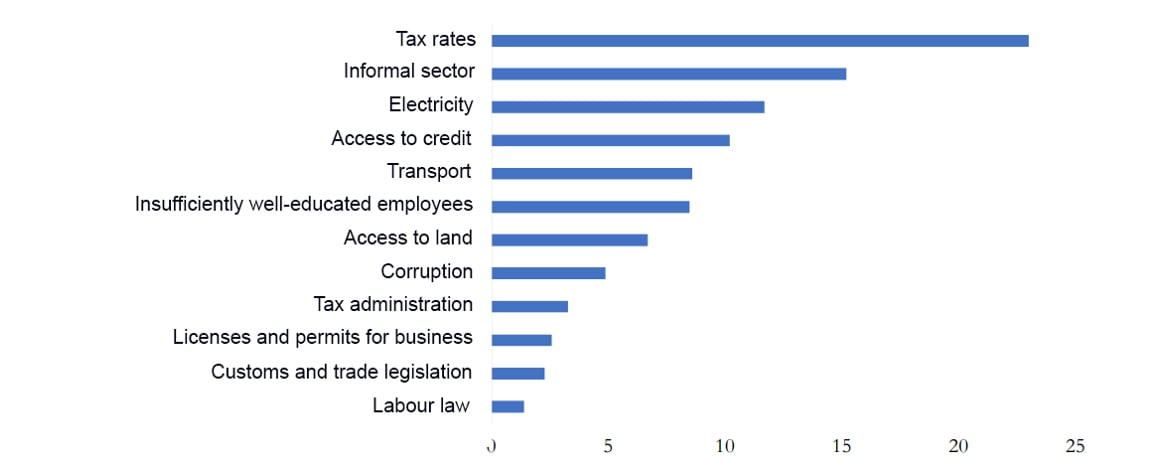 Main obstacles to doing business
(percent of respondents)
Source: World Bank, Uzbekistan Business Survey
A similar situation can be observed in agriculture, where approximately 5,000 farms with land plots of 25 hectares each report only one employee on their payroll. According to the President, about 5 million people work in the informal sector, and employers, by paying them wages, are in fact evading taxes, which exacerbates imbalances in the economy[6].
As a result, the bank’s cash turnover reached 1,011 trillion soums in 2024 and increased by 22% compared to 2023, indicating that cash settlements continue to play a significant role in the country’s financial system[8].
At the same time, according to the World Bank, the use of cash in settlements for goods and services without issuing cash receipts significantly increases the risk of tax evasion and contributes to the increase of shadow turnover in the economy[9].
The concept of a bank account includes all forms of officially opened and registered accounts in banks, including plastic cards, through which non-cash transactions are carried out.
According to another study conducted by the Central Bank of Uzbekistan in collaboration with the ADB, only 7% of bank account holders use them for savings, while 47% do not protect financial applications with passwords, and in southern regions, many don’t even know what to do if they have lost their bank card[11]. The low levels of knowledge and digital skills, especially in rural areas, limit the use of non-cash instruments and formal financial services.
Recommendations for reducing the scale of the shadow economy in Uzbekistan
Reducing the scale of the shadow economy requires a comprehensive approach combining institutional, fiscal, digital and educational measures. In this regard, experts of the Development Strategy Centre propose the following:
First, to accelerate the adoption and implementation of the National Strategy to Combat the Shadow Economy, as this issue was specifically highlighted in the final statement of the International Monetary Fund mission following the 2025 consultations[12]. The mention of this problem at the international level underscores its strategic importance not only for domestic development, but also for strengthening Uzbekistan’s position in the global economy. The implementation of comprehensive measures within the framework of the strategy will reduce the scale of the shadow economy, increase the effectiveness of fiscal policy, and create conditions for sustainable growth.
 Second, it is recommended to consider the possibility of introducing a national mobile application that supports contactless payment technology (Tap to Pay), similar to the Polish experience.
Such a system will allow entrepreneurs to accept all types of non-cash payments – bank cards and digital wallets – without using POS terminals, but only through a smartphone with an NFC module. This will reduce the costs of small businesses, especially in markets and services.
In Poland, entrepreneurs of any scale can safely and conveniently accept contactless payments using Tap to Pay on their mobile phone through the eService tom application. The feature supports credit and debit cards, Apple Pay, and other digital wallets, and payment goes through NFC – it’s enough for the client to bring their plastic card to the seller’s phone. If needed, Tap to Pay also allows you to use the PIN-code. This technology helps sellers manage their businesses more effectively, especially mobile ones – taxi drivers, restaurants, artisans, and other entrepreneurs[13].
In addition, it is advisable to study China’s experience in implementing the WeChat Pay digital ecosystem, where payments are made via QR codes with automatic generation of electronic receipts. Such a model will ensure transparency, convenience and security of payments, as well as accelerate the development of a cashless economy and financial inclusion of the population.
In China, you can pay for goods and services through the WeChat Pay service – from shop purchases and restaurant accounts to utility bills, medical services, and travel bookings. Many users save significant amounts in their digital wallets using QR code scanning as their primary payment method[14].
Third, consider creating a unified electronic platform for trade in agricultural products based on India’s experience, uniting farmers, wholesale markets, and commodity exchanges. This will ensure transparent and competitive pricing, mandatory registration of manufacturers, and reduce the risks of shadow schemes. E-commerce will allow farmers to sell their products directly, without intermediaries, increasing their income and reducing informal practices.
In India, the electronic National Agricultural Market (e-NAM), launched in 2016, unites 1,522 markets (mandis), 267,719 traders, and 17.9 million farmers. The system ensures online sales and transaction transparency. For example, Mahakaushal Progressive Farmers (Madhya Pradesh) increased farmers’ income by 1-2 dollars per centner, while Girimala Farmers Producer Company (Gujarat) increased farmers’ income by 2.7 dollars by eliminating intermediaries[15].
Fourth, it is advisable to integrate financial literacy into school curricula. Teaching personal finance using games and interactive methods (gamification) will help develop budget management skills from an early age.
The possibility of introducing pilot financial literacy programmes for adults should also be explored, especially in rural areas where the use of banking services remains low.
In the United States, more than half of the states have introduced compulsory financial literacy courses. In 16 states, the course is a prerequisite for graduation, and in 11 states, it is integrated into economics programmes[16]. According to surveys by NEFE and AmeriSpeak (2022), 88% of adults support compulsory financial education, and 80% would like to take it themselves. As for the content of the programme, adults identified the most important topics in personal finance as spending and budgeting (75%), credit management (55%), savings (49%) and earning income (47%)[17].
Fifthly, it is recommended to use artificial intelligence in tax administration, following the example of Austria. The use of AI and machine learning will enable the analysis of large amounts of data, the detection of violations and the assessment of risks in real time.
In Austria, the Predictive Analytics Competence Centre (PACC) at the Ministry of Finance used AI to analyse 34 million cases, identifying 375,000 potential violations and raising an additional €185 million in tax revenue in 2023[18].
The introduction of similar technologies in Uzbekistan will increase transparency, strengthen the analytical function of tax authorities, and prevent the development of shadow schemes.
At the same time, it is important to provide for the protection of personal data and the creation of legal guarantees for the use of analytical systems in tax administration.
Sixth, in order to increase the transparency of tax administration, it is recommended to introduce an electronic mechanism for monitoring the actions of tax officials, including the digital recording of all visits to businesses. This will eliminate arbitrary pressure on businesses and increase the confidence of entrepreneurs.
The comprehensive application of the proposed measures will enable Uzbekistan to transition to a new model of economic management based on digitalisation, transparency and trust. The transition to cashless payments, the expansion of financial inclusion and the use of smart technologies in the tax sphere will create conditions for a sustainable reduction in the share of the shadow economy and an increase in the competitiveness of the national economy as a whole.
[1] https://stat.uz
[2] https://president.uz/ru/lists/view/8376
[3] https://lex.uz/docs/4849605
[4] https://t.me/Press_Secretary_Uz/3263
[5] https://documents1.worldbank.org/curated/en/099050625064564692/pdf/P180243-fb284e50-52db-47a6-a10f-0d4e7eb45419.pdf
[6] https://www.gazeta.uz/ru/2024/01/16/shadow-economy/
[7] https://cbu.uz/upload/iblock/406/fl4gg8zihctt0oxwldof05xwufgr46gy/Sorovnoma-natijasi-_2025-y.-iyun_.pdf
[8] https://cbu.uz/upload/iblock/a52/92o5pmh1cjordv18gupuuf0etcrk00er/03_SHarkh_nakd-pul-2024-g.-rus2.pdf
[9] https://openknowledge.worldbank.org/entities/publication/ac342894-d147-5e69-bc7a-3193c55a8957?utm_source=chatgpt.com
[11] https://cbu.uz/upload/iblock/0ea/i206h1ebm6zlfe4po48bqb29wf8ycha8/O_zbekistonda_moliyaviy_ommaboplik_DARAJASINI_baholash_Osiyo_taraqqiyot.pdf
[12] https://www.imf.org/ru/News/Articles/2025/04/23/mcs-042325-uzbekistan-staff-concluding-statement-of-the-2025-article-iv-mission
[13] https://www.eservice.pl/en/aktualnosci/eservice-umozliwia-korzystanie-z-tap-to-pay-na-iphonie-w-polsce
 English
 Русский
 О'zbek


