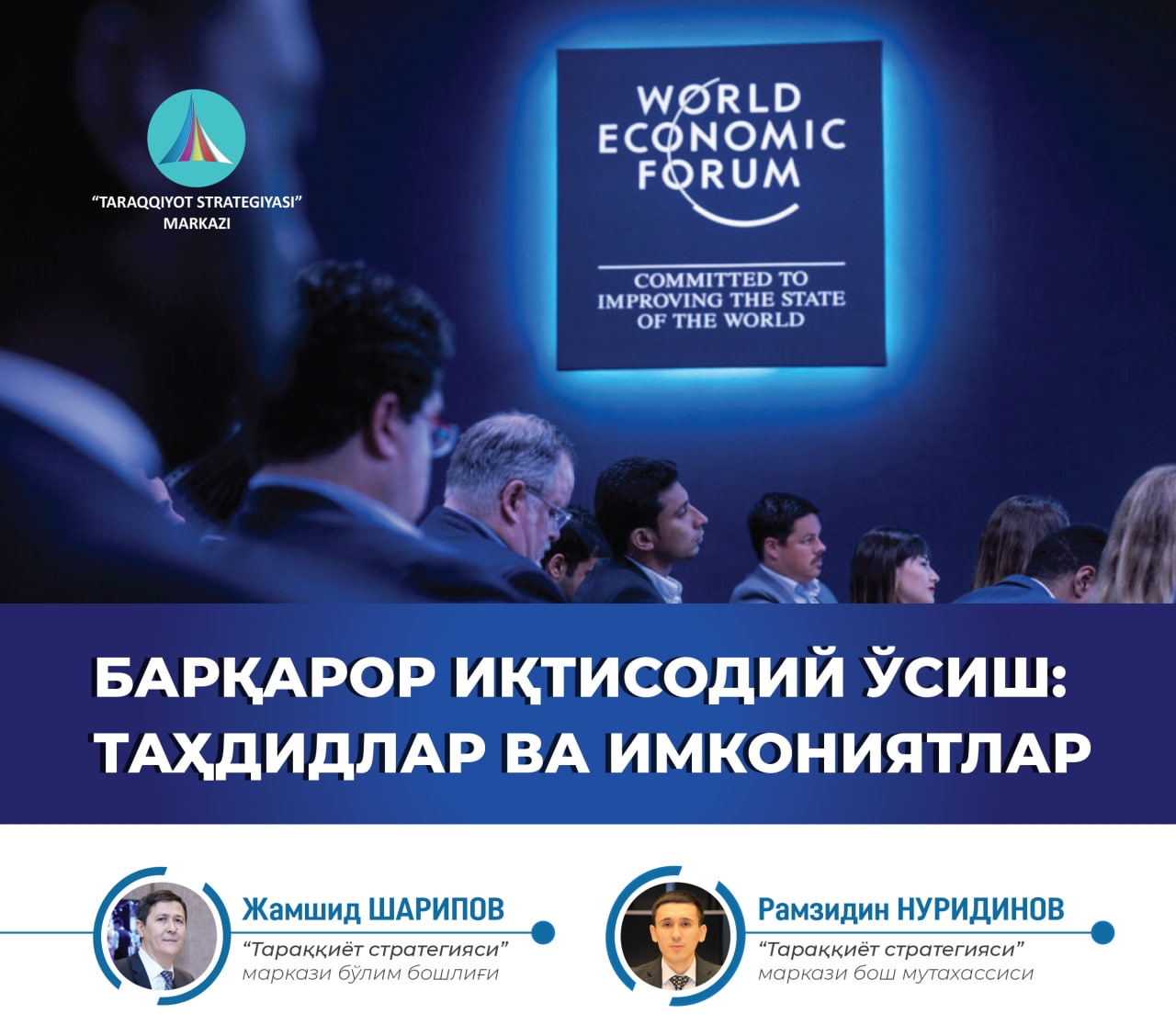
Jamshid Sharipov Head of Department of the Development Strategy Center
Ramzidin Nuridinov Chief Specialist of the Development Strategy Center
In January 2025, the World Economic Forum published its latest Global Risks Report 2025, which presents the results of studies by more than 900 experts from academia, business, governments, international organizations, and civil society from around the world. In the report, a “global risk” is defined as an event or factor that could have a significant adverse effect on world economy, demographics, or natural resources.
The study divides “global risks” into five categories: economic (inflation, debt crisis, unemployment, resource scarcity), environmental (global warming, loss of biodiversity, drought, floods), technological (cyberattacks, technological failures, loss of data privacy), social (income inequality, demographic changes, migration crises), geopolitical (trade wars, military conflicts, political instability).
According to the Global Risks Report 2025, the global risks in the near-term outlook at the global level are ranked by severity in the following order: disinformation, extreme weather events, armed conflict, social polarization and cyberespionage.
In Uzbekistan, whose economy is closely linked to the agricultural sector and the export of natural resources, these challenges, according to experts from the World Economic Forum, require a revision of the growth strategy and adaptation to changing conditions. This analytical material examines the current situation, key issues, proposals and recommendations that, according to experts from the World Economic Forum, will help the country overcome existing obstacles and ensure sustainable economic growth.
Problems and challenges of economic growth
For many countries, including Uzbekistan, ensuring economic growth in the context of global uncertainty is one of the key tasks. Thanks to large-scale reforms, infrastructure modernization and investment attraction, in 2024 Uzbekistan's economy continued to demonstrate positive dynamics. In particular, the poverty rate decreased to 8.9%, inflation - to 9.8%, GDP grew by 6.5%, and exports - by 8.3%.
Despite these achievements, according to World Economic Forum experts Uzbekistan may face five key risks. Among the main challenges that could hinder the country's sustainable development, the Global Risks Report 2025 highlights the shortage of water and energy resources, air, water and soil pollution, the growth of public debt, as well as a shortage of labour and specialists.
Key risks for 122 countries, including Uzbekistan in the Global Risks Report 2025 are identified based on the results of the Executive Opinion Survey[1].
|
World |
Uzbekistan |
|
1. Disinformation |
1. Water shortage |
|
2. Extreme weather events |
2. Energy shortage |
|
3. Armed conflict |
3. Pollution (air, water, soil) |
|
4. Social polarization |
4. Government debt |
|
5. Cyberespionage and military activities |
5. Shortage of labour and specialists |
The following is an analysis of each of the risks that, according to research by the World Economic Forum, could affect stable economic growth in Uzbekistan.
Water and energy shortage (risks 1 and 2). Uzbekistan, being a country with an arid climate, faces an acute shortage of water resources. This is due to both natural conditions and inefficient use of water in agriculture, which consumes about 90% of the country's water resources. For example, 10-11 thousand cubic meters of water are spent annually to irrigate 1 hectare of cotton field, while in countries with similar climate and soil - 2-3 times less. Also, the country loses 36% of water due to outdated irrigation infrastructure[1]. Moreover, further climate change may worsen the problem: according to expert forecasts, by 2030, water availability in the region may decrease by 20-25%.
In addition, population and industrial growth are increasing the load on the energy system, leading to power shortages. In 2023, the power shortage was 5%, leading to rolling blackouts in a number of regions[2].
Air, water and soil pollution (risk 3). According to research by the World Economic Forum, Uzbekistan faces serious environmental problems, including air pollution in major cities, soil degradation and water pollution. This is due to intensive industrial development, the use of outdated technologies and insufficient attention to environmental standards.
These findings are also confirmed by the IQAir portal data, according to which the PM2.5 concentration in Tashkent is 13.4 times higher than the WHO recommended level. The main sources of PM2.5 air pollution are the heating sector (28%), transport (16%) and industry (13%). It should be noted that this situation can lead to serious consequences for public health, as well as significant economic costs[3].
According to World Bank experts, by 2030, about 8 million people in Uzbekistan may be affected by environmental problems and will live in high-risk areas, and if there is no action, the country may lose 10 units of GDP growth in the long term[4].
Public debt (risk 4). The growth of Uzbekistan's public debt is causing concern among the World Economic Forum experts. Although the country is actively attracting foreign loans to finance infrastructure projects, this may lead to a debt burden, especially in the context of global economic instability.
According to the Ministry of Economy and Finance of the Republic of Uzbekistan, as of January 1, 2024, the public debt amounted to $34.9 billion or 34.4% of the gross domestic product (GDP), which is close to the threshold of 55% set by the International Monetary Fund for middle-income countries[5]. At the same time, according to experts from the World Economic Forum, the bulk of the debt is external borrowing, which makes the country vulnerable to fluctuations in exchange rates and changes in interest rates on international markets.
Shortage of labour and highly qualified specialists (risk 5). Despite the high level of youth unemployment, which, according to the Agency of Statistics under the President of the Republic of Uzbekistan, was about 13.5% in 2023, Uzbekistan faces a shortage of qualified personnel, especially in high-tech industries such as IT, engineering and green energy. This is due to the discrepancy between the education system and the requirements of the labour market: i.e., curricula are not oriented to the needs of employers.
According to the Minister of Employment and Poverty Reduction of Uzbekistan, 59% (or 126 thousand) of young specialists who graduated from higher education institutions in 2024 are not yet able to find employment in their specialty[6]. These data were announced during a hearing of the results of his activities in the Legislative Chamber of the Oliy Majlis. The reason for this, according to the World Bank report "Youth Employment in Uzbekistan", is that 69% of young people who graduated from educational institutions are not ready for work due to lack of experience and necessary skills[7].
Suggestions and recommendations for overcoming the above problems
International experience shows that coordinated and strategically thought-out actions can significantly improve the economy and enhance the quality of life of the population.
According to research by the World Economic Forum, solving the aforementioned problems requires a comprehensive approach, introduction of modern technologies and adaptation of successful foreign practices used to overcome similar challenges and risks, in particular:
I. Solving the problem of water and energy shortages.
According to experts from the World Economic Forum, the way out of the water crisis and energy shortage is “green development”.
Based on the above, experts from the Development Strategy Center consider it appropriate to take measures in the following four main areas to mitigate water and energy shortages based on best international practices:
Israel, thanks to advanced technologies of drip irrigation, seawater desalination and wastewater recycling, has been able to significantly alleviate the problem of water shortage. As a result, about 90% of wastewater in Israel is recycled and used in agriculture, which allows for an average saving of 40% of water[8]
In China, the “Made in China 2025” plan encourages the development of domestic production of solar panels and wind turbines. In 2023, China’s solar power capacity reached 609.49 GW, and wind power capacity reached 441.34 GW[9]. China’s investment in renewable energy in 2023 amounted to $546 bn[10].
Since the 2000s, Germany has been pursuing an Energiewende (energy turnaround) policy aimed at phasing out coal and nuclear power. Germany’s Energiewende strategy has led to a significant increase in renewable energy generation. In 2023, solar and wind power plants accounted for 56% of all electricity generation in Germany. By 2050, the country plans to reduce greenhouse gas emissions by 80–95% compared to 1990 levels. By mid-century, it also plans to obtain 60% of its energy from renewable sources such as wind and solar power[11].
Also, Germany introduced the “Renewable Energy Sources Act” (EEG), which provided for additional financial support to those who produced decentralized energy and fed it into the general network, for which they received a special tariff component. The main goal of the EEG is to stimulate investment in “green” energy, making it economically attractive for producers[12].
China is actively building “Smart Grids” that integrate renewable energy sources and transmit energy from the western regions (where there is a lot of sun and wind) to the eastern industrial centres[13].
Consideration of the possibility of introducing a tax on CO₂ emissions in Uzbekistan for large enterprises polluting the environment, based on the successful experience of Sweden.
In Sweden, the introduction of a “green tax” on carbon dioxide emissions has become a powerful tool for stimulating companies to switch to environmentally friendly technologies. Thanks to this, Sweden has reduced greenhouse gas emissions by 27% since 1990[14].
The introduction of such a tax could play an important role in achieving sustainable development by helping to reduce environmental impacts, improve energy efficiency and promote green technologies.
1. Implementation of effective budgetary measures, stimulation of development of small and medium-sized businesses, as well as reduction of non-targeted expenditures based on the experience of Canada, when the country faced a high level of public debt exceeding 70% of GDP.
To address the high level of public debt, Canadian authorities have implemented comprehensive budget reforms aimed at reducing excessive public spending and increasing revenues. One of the key elements of the reforms has been active support for entrepreneurship, which has played an important role in stimulating economic growth and creating new jobs[15].
2. Implementation of a fiscal rules system similar to that of South Korean practice, which effectively limits the volume of government borrowing. Such a system helps maintain fiscal discipline and stability by ensuring control over the level of government debt and preventing its excessive growth.
As a result of introduction of a system of fiscal rules in South Korea, it was possible to keep the national debt at a relatively low level - about 40% of GDP[16].
South Korean practice shows that the application of such fiscal rules contributes to the sustainability of the national economy, improves macroeconomic stability and strengthens investor confidence.
1. Implementing the "Dual Learning" program based on the successful experience of Germany.
In Germany, within the framework of this program, students simultaneously receive education at higher education institutions and undergo practical training at enterprises with which the universities have concluded cooperation agreements, i.e., from the first day of study, students harmoniously combine theory and practice.
This approach not only helps to facilitate the mastery of theoretical knowledge, but also allows you to acquire important practical skills in a real business environment, as well as obtain a bachelor's or master's degree, fully immersing yourself in professional activities[17].
2. Introducing in Uzbekistan a programme to finance additional education and retraining of workers, similar to the Singaporean SkillsFuture model.
Singapore's SkillsFuture initiative aims to enhance skills and improve the competitiveness of employees in the labour market. Thanks to this approach, over 70% of graduates in Singapore find employment immediately after completing their studies[18].
3. Consideration of the possibility of concluding bilateral agreements on the exchange of experience and advanced training of citizens, providing for internships at leading factories and large companies abroad with subsequent return to their homeland to apply the acquired knowledge and skills.
In 2017, India signed a Memorandum on Cooperation in skills development with Japan.
Under the Technical Internship Training Programme (TITP), launched by Japan to support developing countries through On-the-Job Training, Indian nationals undergo training in Japan for a period of three to five years and then return to India to apply the knowledge and skills they have acquired[7] https://documents1.worldbank.org/curated/en/235891634705237783/pdf/Youth-Employment-in-Uzbekistan-Opportunities-and-Challenges.pdf
[8] https://blogs.timesofisrael.com/water-technology-and-agriculture-sustaining-israels-development/
[9] https://www.enerdata.net/publications/daily-energy-news/chinas-solar-power-capacity-soared-55-2023-and-wind-capacity-21.html#:~:text=China’s%20National%20Energy%20Administration%20(NEA),1.8%25%20to%20above%20421%20GW
[10] https://about.bnef.com/blog/global-low-carbon-energy-technology-investment-surges-past-1-trillion-for-the-first-time/
[11] https://www.wartsila.com/insights/article/energiewende-germanys-quest-to-achieve-a-100-percent-renewable-energy-future#:~:text=Germany’s%20Energiewende%20(the%20energy%20transition),and%20solar%20power%20by%20mid-century
[12] https://www.wind-energie.de/english/policy/rea/
[13] https://energycentral.com/news/smart-grids-boost-digitalization-efforts-stable-energy-supply
[14] https://taxfoundation.org/research/all/eu/sweden-carbon-tax-revenue-greenhouse-gas-emissions/
[15] https://globalfinancialdata.com/paying-off-government-debt#:~:text=Unlike%20Australia%2C%20Canada%20kept%20its,to%20over%206%25%20of%20GDP
[16] https://english.moef.go.kr/pc/selectTbPressCenterDtl.do?boardCd=N0001&seq=4993
[17] https://www.mygermanuniversity.com/articles/dual-study-programs-in-germany
[18] https://www.moe.gov.sg/news/parliamentary-replies/20201005-measuring-skillsfuture-and-employment-outcomes
 English
 Русский
 О'zbek


