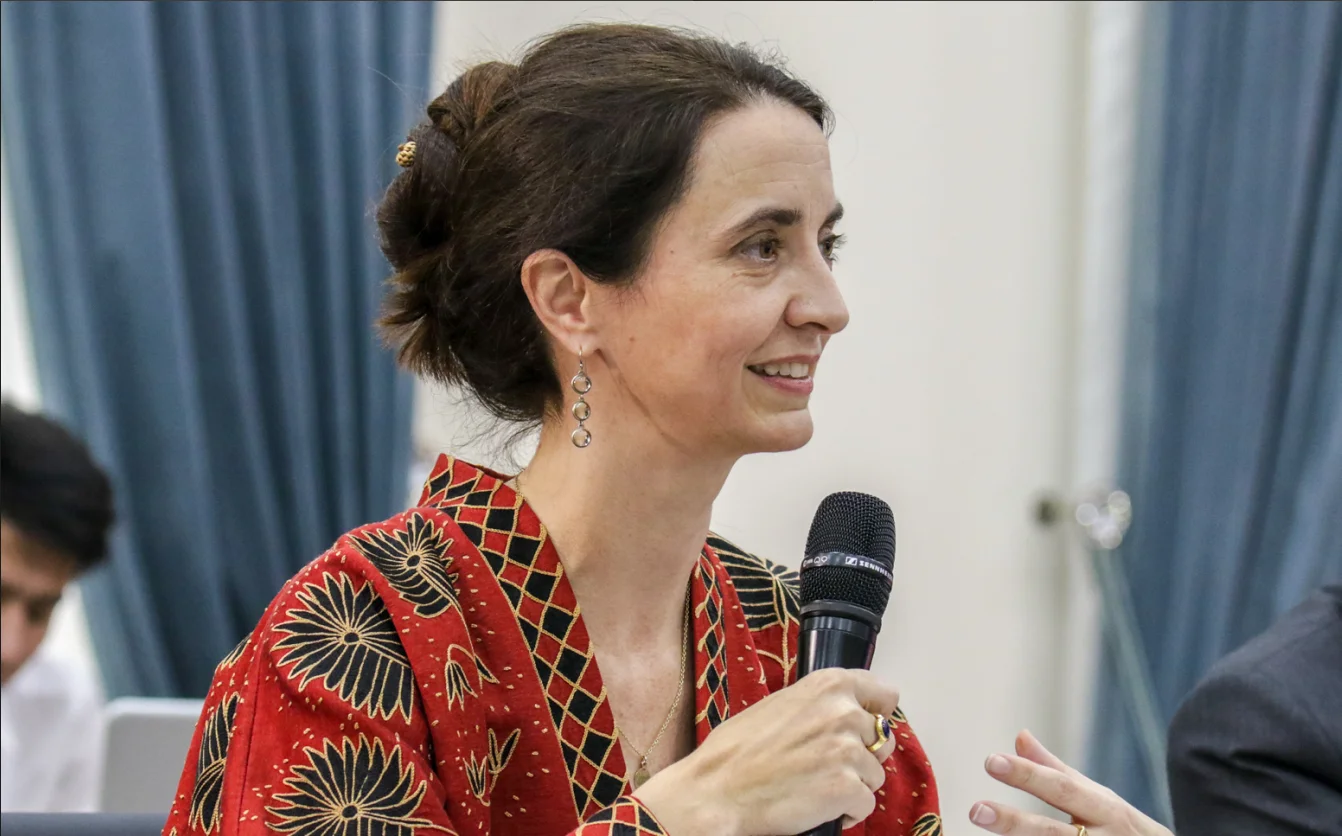
Helena Fraser,
UN Resident Coordinator in Uzbekistan
As is publicly known, in pursuance of the UN General Assembly Resolution No 70, adopted at the Summit on Sustainable Development in September 2015, and aiming at ensuring the consistent implementation of the 2030 UN Global Agenda for Sustainable Development, the Cabinet of Ministers of Uzbekistan adopted a Resolution ‘On measures to implement national goals and objectives of sustainable development for the period until 2030’.
Along with that, as part of the implementation of the SDG Five Uzbekistan has developed nine objectives aimed at ‘Ensuring gender equality and empowering all women and girls’.
Under SDG Five on gender equality, by 2030 Uzbekistan is committed to end all forms of discrimination against all women and girls everywhere, to ensure women’s full and effective participation and equal opportunities for leadership at all levels of decision-making in political, economic and public life. The SDG Five also provides for the optimal implementation of the principles of gender equality in the process of adoption of state programs at different levels of governance.
The recent initiatives to ensure gender equality and increase the role of women in the socio-political life of the country have been carried out in several areas:
● Improvement of legislation on women's rights;
● Improvement of the institutional framework for the protection of women;
● Raising public awareness of gender equality and women's rights;
● Training executives the relevant legal norms to ensure their enforcement.
In this context, Uzbekistan adopted certain legislative acts, including decrees and resolutions of the President on ensuring women’s rights, specifically, on gender equality, on protecting women from oppression and violence, and on strengthening the status of women's entrepreneurship.
From the point of view of ensuring gender equality, it is worth noting positive changes in education. In particular, since 2017, most universities opened part time departments in various specialties. This form of education empowers young women to care for children and fulfill other family obligations.
Taking this opportunity, I find it sensible to quote from the speech of President Shavkat Mirziyoyev at the twentieth plenary meeting of the Senate of the Oliy Majlis on June 21, 2019:
“I am anxious about the stereotype that is rooted in the minds of our people. Normally, we revere a woman, primarily as a mother, the guardian of the family hearth. This is certainly true. However, today every woman should not be a passive bystander, but an active and proactive participant in the ongoing democratic transformations in the country.”
That day, by the proposal of the President, for the first time in the history of the country a woman Tanzila Narbaeva was elected the new Chair of the Senate. As you know, Tanzila Narbaeva held the post of Deputy Prime Minister of the Republic of Uzbekistan, Chaired the Women's Committee of Uzbekistan.
Mentioning legislative action taken in this area, in September 2019, the Laws ‘On guarantees of equal rights and opportunities for women and men’ and ‘On protecting women from harassment and violence’ were adopted in Uzbekistan in order to further improve the legal framework for ensuring and protecting women’s rights.
Almost all UN agencies, including the United Nations Development Program, the United Nations Population Fund (UNFPA), the United Nations Children's Fund (UNICEF), the Office of the United Nations High Commissioner for Human Rights, the United Nations Office on Drugs and Crime (UNODC), the International Organization for Migration made comments and proposals on the two abovementioned laws.
With regard to institutional measures for gender equality, Uzbekistan established a new Committee on Women and Gender Equality in the Senate of the Oliy Majlis, which deals with the implementation of international standards in the national legislation to ensure the rights of women and the elimination of all forms of discrimination. In order to further strengthen labor rights guarantees and support, to assist victims of domestic violence, the Republican Center for Rehabilitation and Adaptation of Victims of Violence and Prevention of Suicide, Center for Women's Entrepreneurship and the Scientific and Research Center Oila under the Cabinet of Ministers were established.
Importantly, all newly created institutional mechanisms, together with the Women's Committee of Uzbekistan, and in accordance with the UN Convention, have turned into an integral and unified mechanism for ensuring women's rights, gender equality and the elimination of discrimination against women.
The adopted legal documents and practical action are important steps along the gender policy of Uzbekistan, which is fully consistent with international norms and standards of lawmaking and the law-making practice. At the same time, part of these documents and measures is based on the proposals of UN human rights institutions.
The adoption of the Law ‘On Protecting Women from Harassment and Violence’ is an important step forward. It was adopted after many years of discussion. Currently, the law is the bedrock for protecting women by providing assistance to victims of domestic violence, providing them with asylum, by imposing responsibility not just for physical violence, but also for psychological or economic crimes, as well as through helplines for victims of harassment and violence. Relevant UN human rights institutions have been proposing such measures for a long time.
In the field of monitoring and evaluating the effectiveness of gender policy, 54 additional gender indicators introduced on the website www.gender.stat.uz have entailed important changes.
Apart from that, there is a need to take long-term consistent measures in this area. In this context, it is important to not just adopt such indicators, but also ensure their compliance with international commitments and standards, their timely and accurate implementation on the ground. It is vital to continue consistent efforts to ensure the full and effective participation of women at all levels of decision-making in political, economic and public life.
Therefore, to implement the laws ‘On guarantees of equal rights and opportunities for women and men’ and ‘On protecting women from harassment and violence’, it is planned to adopt a Roadmap. There is also a plan to adopt a National Strategy for Gender Equality. UN agencies are ready to continue supporting Uzbekistan in gender equality and discrimination issues, specifically, in terms of planning, development and implementation of special documents, in the development of special criminal and procedural provisions, and in executive stages of new codes.
In order to achieve the integrity of the adopted documents of a certain level for women and men, it is essential to ensure the mandatory conduct of gender examination of legislative activities.
In turn, along with business incubators, it is advisable to take measures to stimulate women in the field of education and science, or engage them in natural and technical sciences by creating STEM (science, technology, engineering, mathematics) laboratories. This, in turn, will help increase women’s employment and their competitiveness in the modern labor market.
The measures taken should cover all regions of the country and all categories of women. It is relevant to take into account the principles of consistent implementation of the Sustainable Development Goals of the 2030 UN Global Agenda, specifically, the principle of “not leaving anyone ignored”, and pay close attention to women prone to various forms of discrimination. This applies to women living in villages in remote areas of the country, ethnic minority groups, people with disabilities, women with HIV/AIDS, women in places of deprivation and restriction of freedom (including prisons, boarding houses, nursing homes and mental asylums), human rights defenders, stateless persons and refugees.
Meanwhile, in the framework of collaboration of UN agencies in Uzbekistan, a special group on gender issues was established. It consists of representatives of almost all UN agencies. For example, making recommendations on the above laws was part of the work of this group during the project. By the example of the group, UN agencies are always willing to assist in the development of other legislative documents.
In addition, the agenda includes many measures to increase awareness of women's issues through various communication formats, like conferences, videos, legal clinics under the Women's Committee of Uzbekistan, social networks. In this area, we have been actively working with the Development Strategy Center and other non-governmental organizations.
In turn, the UN team in Uzbekistan, within the framework of the ‘Sustainable Development Cooperation Program 2021-2025’, which is currently being developed with active involvement of all national partners and other stakeholders, continues to provide comprehensive assistance to the republic in ensuring gender equality.
 English
 Русский
 О'zbek


