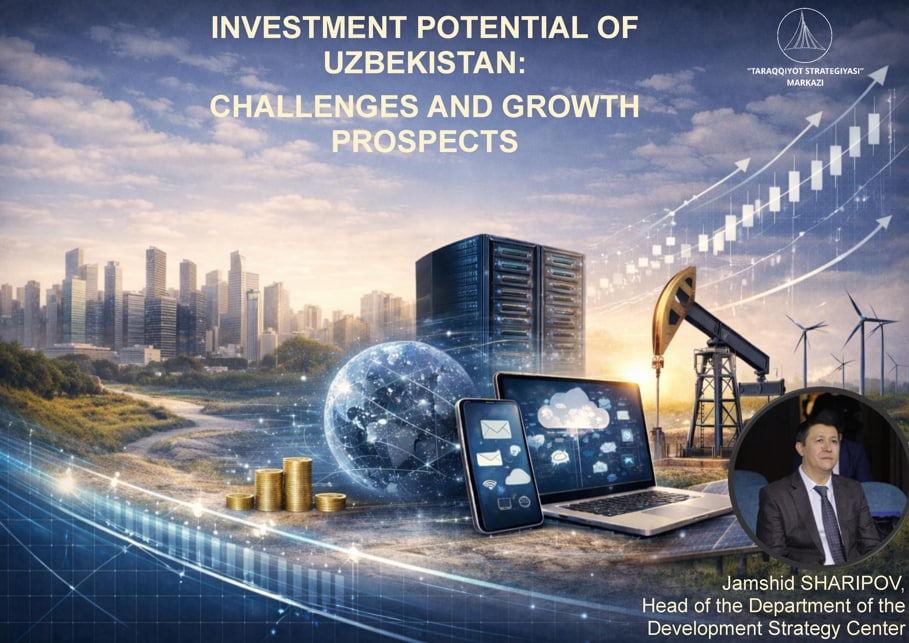
Jamshid SHARIPOV,
Head of the Department of the
Development Strategy Center
Attracting investments is one of the key factors for sustainable economic growth, structural transformation of the economy, and development of entrepreneurship. Within the framework of the implementation of the “Uzbekistan-2030” Strategy, not only increasing the volume of investments but also improving their quality, as well as strengthening the contribution of private sector to growth of productivity, employment, and incomes of the population, becomes especially important.
Since 2017, Uzbekistan has been implementing a large-scale program of economic reforms aimed at liberalizing the economy, improving the business environment, and intensifying investment activity. The measures taken contributed to strengthening macroeconomic stability and creating more favourable conditions for attracting both domestic and foreign investments.
As a result of the reforms carried out, the volume of gross domestic product increased from $72.2 billion in 2017 to $121.4 billion in 2024, ensuring an average annual growth rate of 6-7 percent. GDP per capita increased from 2,228 to 3,265 US dollars, the inflation rate decreased from 14.4 to 9.8 percent, State budget revenues increased from 49.7 to 274.4 trillion soums, and the volume of investments in fixed capital increased from 72.2 to 493.7 trillion soums.
The latest report of the Organisation for Economic Co-operation and Development (OECD) “Roadmap for Sustainable Investment Policy Reforms in Uzbekistan” emphasizes that at the current stage, the issue of investment quality and its effectiveness, as well as the economy’s ability to transform investment flows into sustainable development of entrepreneurship and the private sector, is becoming crucial. In this context, the OECD report is aimed at assessing the current investment situation, identifying systemic limitations, and formulating policy priorities for further improving Uzbekistan’s investment climate.
The OECD report notes that after the start of large-scale reforms in 2017, investment climate conditions in Uzbekistan were significantly improved, including the liberalization of the currency regime and the renewal of the legal base. These measures contributed to the growth of investor interest and the formation of a more favourable environment for economic development.
Analysis of the dynamics of foreign direct investments (FDI), the volume of which increased from $3.3 billion in 2017 to $35 billion in 2024, confirms the growing role of FDI in maintaining economic growth and expanding the private sector participation in the economy. Despite the steady growth of FDI, their structure remains highly concentrated, with a significant portion of investments focused in primary sectors, which is characteristic of energy and resource-intensive industries.
The OECD notes that foreign companies in Uzbekistan are generally characterized by higher labour productivity and salary levels compared to local firms. At the same time, the effects of applying technologies, management practices, and professional skills to the national economy remain limited. The entrepreneurial sector, especially small and medium-sized enterprises (SMEs), is still weakly integrated into value chains and is not sufficiently involved in investment processes.
Despite the progress made in forming a more open and investment-oriented economy, the OECD report emphasizes that at the current stage, the further improvement of Uzbekistan’s investment climate is being hindered by a number of systemic factors. These challenges are primarily institutional and structural in nature and limit the economy’s ability to transform investment flows into sustainable growth in entrepreneurship, productivity, and household incomes.
2.1. Limited predictability and fragmentation of regulation
The OECD indicates that the rapid pace of reforms has led to excessive law-making, frequent changes in legislation, and the active use of by-laws. This creates regulatory uncertainty and increases transaction costs for investors and entrepreneurs, especially small and medium-sized enterprises and foreign companies.
Insufficient coordination between agencies and intersecting mandates of government bodies hinder the implementation of investment policy and reduce its effectiveness.
2.2. Limited competition and the persisting major role of the state
The OECD calls the dominance of state-owned enterprises in a number of key sectors of the economy a significant challenge. The availability of preferences in access to financing, land, and investment incentives distorts the competitive environment and reduces private sector incentives to expand investment activity. While unequal competition conditions persist, the potential of entrepreneurship and private investment remains underutilized.
2.3. Limited quality and diversification of foreign direct investment
Although the volume of FDI in Uzbekistan has increased significantly, the OECD notes its high concentration in capital-intensive sectors, primarily in energy. The contribution of investments to diversifying the economy, developing exports, and increasing overall factor productivity remains limited.
The effects of technology and management practices spreading to national companies are hampered by weak integration of SMEs into the value chains and insufficient level of their competencies.
2.4. Inconsistency of investment incentives with sustainable development priorities
According to the OECD, the system of investment and tax incentives in Uzbekistan is characterised by a high degree of discretionality, a predominance of tax reliefs and insufficient transparency. The lack of regular evaluation of the effectiveness of incentives limits their contribution to the development of entrepreneurship and the achievement of the goals of green and digital transformation of the economy.
Taking into account the challenges identified, the OECD formulates a number of priority policy areas, the implementation of which will improve the quality of investment and strengthen their contribution to the development of entrepreneurship and the private sector.
3.1. Improving the quality of regulation and institutional coherence
The OECD recommends shifting the emphasis from the number of adopted normative acts to the quality of their implementation and the stability of regulation.
According to the OECD, key measures include:
3.2. Formation of equal conditions for competition and public sector reform
To unlock the potential of private investments, it is emphasized the need in:
3.3. Transition to a strategy for attracting “quality” investments
The OECD recommends shifting from focusing on the volume of FDI to a strategy for attracting high-value-added investments focused on economic diversification and export development.
In this context, the priorities are:
3.4. Reform of investment incentives and alignment with sustainable development goals
In order to increase the effectiveness of state support, the OECD recommends to:
According to the OECD’s conclusions, Uzbekistan’s investment climate has significant growth prospects. However, realising these prospects requires a consistent transition from extensive investment growth to a qualitative investment model based on competition, entrepreneurship development and effective institutions.
 English
 Русский
 О'zbek


